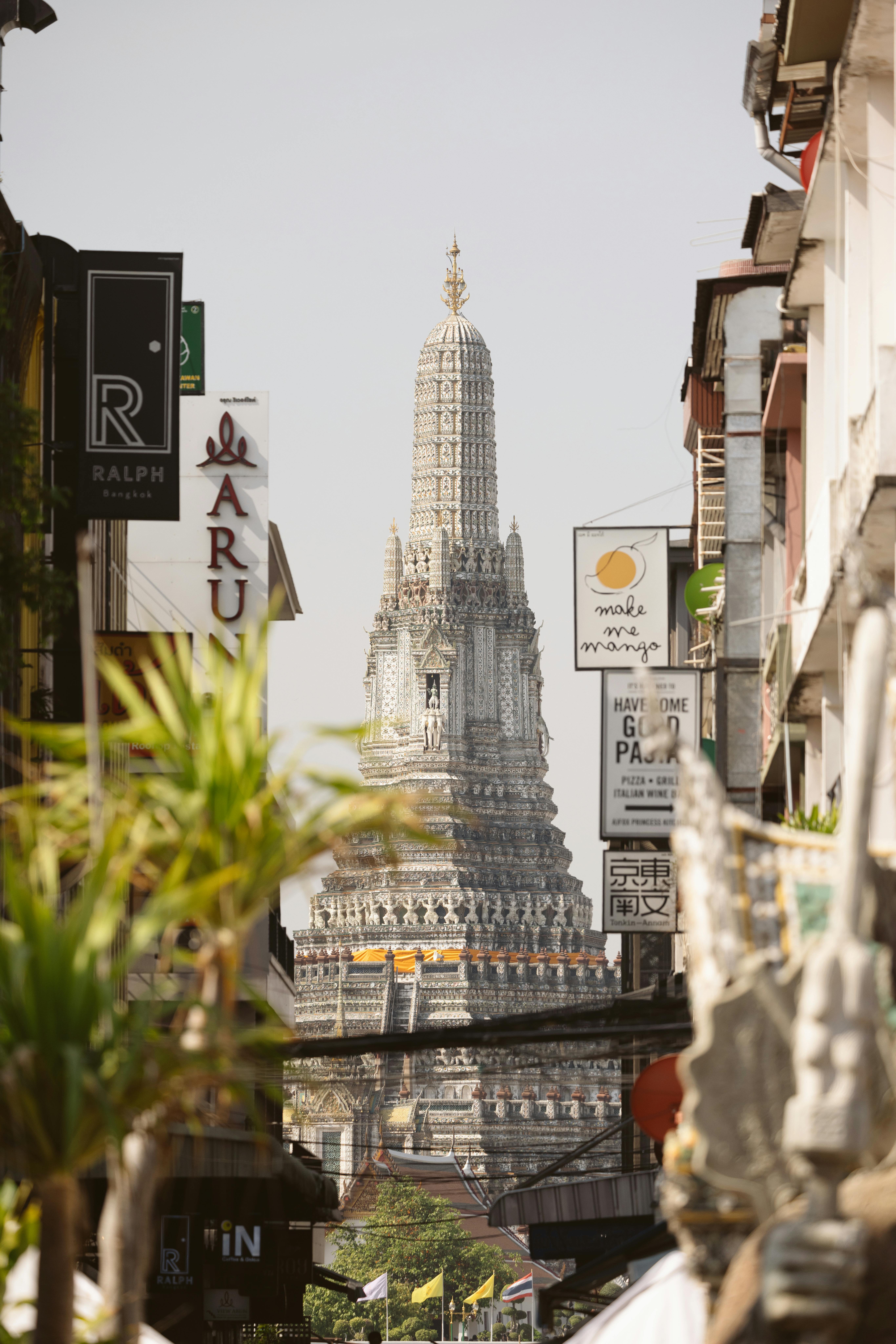
Bangkok is the capital of Thailand and, with around 10 million people in the wider metropolitan area, by far its largest city. It sits on the Chao Phraya River in the central plains and is the country's main international gateway: most trips to Thailand begin or end here.
The city divides loosely into the historic riverside around Rattanakosin, where the royal palace and the oldest temples stand, and the modern commercial districts to the east, linked by the elevated BTS Skytrain and the MRT subway. Where you stay shapes the trip, because the rail lines reach some areas and not others.
Getting there
Bangkok is the arrival point for most visitors to Thailand and the hub for onward travel to the rest of the country. It has two airports.
From the airports
Suvarnabhumi (BKK)
30–60 min to centreThe main international airport, about 30 km east of the centre. The Airport Rail Link runs to Phaya Thai and connects to the BTS; metered taxis and app-based cars serve the whole city. Handles most full-service and long-haul flights.
Don Mueang (DMK)
30–60 min to centreThe older northern airport, about 25 km from the centre, and the base for low-cost carriers such as AirAsia, Nok Air, and Thai Lion. Reached by airport bus, taxi, app car, or the SRT Red Line commuter rail.
Direct flights connect Bangkok with most of Asia, the Middle East, Europe, and Australia. From here, domestic flights, overnight trains, and long-distance buses reach the whole of Thailand.
Airport transfer · At both airports, use the official public-taxi queue or an app (Grab, Bolt) rather than drivers who approach you inside the terminal.
Weather by season
Bangkok sits on the central plains and is warm to hot all year with high humidity. It has three broad seasons: a cooler dry season from November to February, a hot season from March to May, and a wet season from June to October when the southwest monsoon brings frequent afternoon storms.
Year-round climate
Jan
Feb
Mar
Apr
May
Jun
Jul
Aug
Sep
Oct
Nov
Dec
Conditions by month
Seasonal averages for the Central Thailand. Tap through to the monthly weather guide for detail.
Cool & dry
Nov–FebThe most comfortable time to visit, with lower humidity and daytime highs in the low 30s Celsius. The busiest tourist season.
Hot season
Mar–MayThe hottest months, with highs often above 35°C and high humidity. April is the peak, and the Songkran water festival falls on 13–15 April.
Green season
Jun–OctThe monsoon brings heavy but usually short downpours, most often in the late afternoon. Streets in low-lying areas can flood after the heaviest storms; September and October are wettest.
Trip planner
Planning Bangkok? See which days suit it.
The free trip planner shows the seasonal weather verdict for Bangkok on your dates, how long it takes to get there from your other stops, and where to book.
Where to stay
Where to stay
Where to stay in Bangkok
The old city sits on the river; the modern districts follow the BTS and MRT lines east. Tap an area to see where it is and a few hotels at each price level.
Riverside & the Old City
River boats + Grab (no BTS)Best for: Temples, historic sights, first-time visitors
The historic core around the Grand Palace, Wat Pho, and Wat Arun, beside the Chao Phraya River. It has the major temples and the most atmosphere, but no BTS or MRT, so getting around relies on river boats, taxis, and app cars.
On the map
- Khao San Road
- Grand Palace
- Wat Pho
- Wat Arun
Hotels to shortlist
Mandarin Oriental Bangkok Splurge
Historic riverside landmark.
Sala Rattanakosin Boutique
Rooftop facing Wat Arun.
Rambuttri Village Inn Budget
Near Khao San Road.
Agoda · Affiliate link
Getting around
Bangkok has an extensive rail network. The elevated BTS Skytrain and the MRT subway are the fastest way across the central city and avoid the traffic; the Airport Rail Link ties Suvarnabhumi into the system. The Chao Phraya Express boats and cross-river ferries serve the riverside and the old city, which the rail lines do not reach.
App-based ride-hailing (Grab, Bolt, inDrive) and metered taxis are widely available and inexpensive, though road traffic is heavy at peak times. Motorcycle taxis, whose riders wear numbered vests, handle short trips down the long sois. Tuk-tuks operate mainly for tourists and are negotiated rather than metered.
Things to do
- The riverside temples. The Grand Palace and Wat Phra Kaew, Wat Pho (the reclining Buddha), and Wat Arun form the historic core, best reached by river boat.
- Markets. The Chatuchak Weekend Market is one of the world's largest; the city also has floating markets and countless day and night markets.
- Chinatown (Yaowarat). The dense street-food district, busiest in the evening.
- Rooftop bars & the river. Bangkok is known for its high rooftop bars and for dinner cruises along the Chao Phraya.
- Day trips. Ayutthaya, the floating markets at Damnoen Saduak and Amphawa, and the Maeklong railway market are all within reach for a day.
Local character & practical notes
Bangkok pairs one of the world's densest street-food cultures with modern malls and rail transit. Temples (wat) require modest dress covering shoulders and knees, and the Grand Palace enforces this strictly.
The city is the hub for onward travel: overnight trains leave from Krung Thep Aphiwat Central Terminal, domestic flights from both airports, and long-distance buses from the northern (Mo Chit) and southern (Sai Tai Mai) terminals.
During Songkran (13–15 April), Silom Road and the Khao San area become major sites for the water-festival celebrations.
Going deeper
Opinion & first-hand guides to Bangkok
This page keeps to the facts. For recommendations and first-hand takes, these blog posts go further.
Blog · 28 September 2026
Koh Kret: A Car-Free Island Upriver From Bangkok, Done in Half a Day
Koh Kret is a car-free Mon island in the Chao Phraya that you reach with a Grab and a 3 baht ferry, and cycle round in half a day.
Blog · 24 September 2026
Bang Kachao: Bangkok's Green Lung, and a Tree House to Sleep In
A loop of palm forest and village paths five minutes by boat from Bangkok. Cycle it in a morning, or stay the night at the Bangkok Tree House.
Blog · 28 August 2026
One Day in Bangkok: How I'd Show It to a Friend
If I had one day to show a friend Bangkok, here's the exact route I'd take: a local morning market, a river boat to Talad Noi, and Wat Arun at golden hour.
Blog · 6 May 2026
Where to Stay in Bangkok: Best Areas for Your Trip
Where you stay in Bangkok shapes the whole trip. The best area for first-timers, nightlife, families, food and budget, and the one rule that beats the rest.