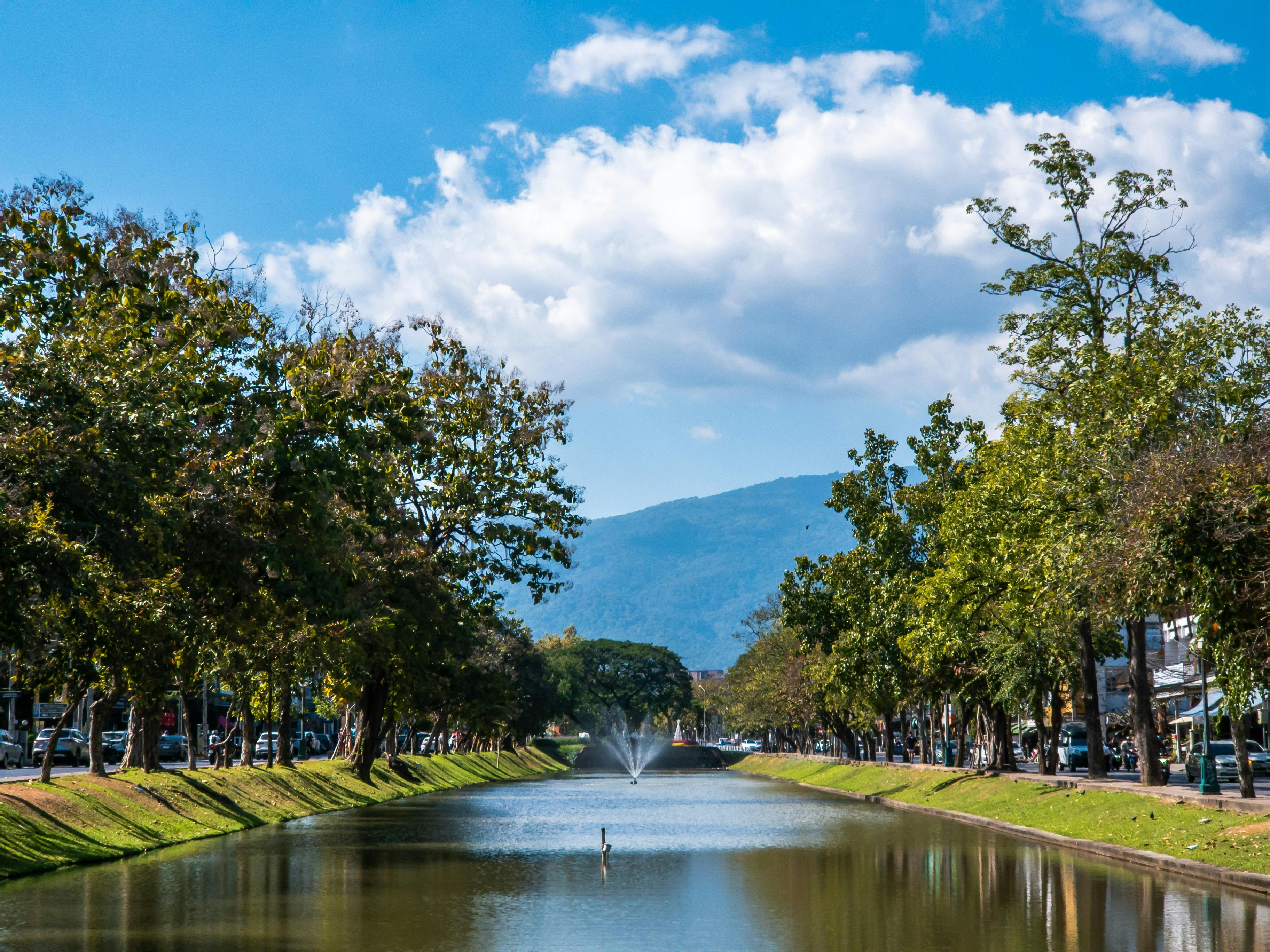
Chiang Mai is the largest city in northern Thailand and the region's cultural and transport hub, about 700 km north of Bangkok. It sits in a mountain valley on the Ping River and is known for its dense concentration of temples, cooler weather than the lowlands, and a slower pace than Bangkok.
The historic centre is a square roughly 1.5 km on each side, bounded by a moat and the remains of the old city wall. Most of the sights, guesthouses, and markets are inside or just outside the moat, with newer districts spreading west toward Nimmanhaemin and east toward the river.
Getting there
Chiang Mai is well connected to Bangkok by air, rail, and road, and has its own international airport a short drive from the old city.
From Bangkok
Flight
1h 20mFrequent direct flights from both Bangkok airports to Chiang Mai International Airport (CNX). The fastest option, and often inexpensive if booked ahead.
Check schedules on 12Go →Overnight train
11–13hSleeper trains run from Bangkok's Krung Thep Aphiwat Central Terminal to Chiang Mai, a scenic route best taken overnight.
Check schedules on 12Go →Bus
9–11hVIP overnight coaches leave Bangkok's Mo Chit terminal for Chiang Mai's Arcade bus station.
Check schedules on 12Go →
Chiang Mai International Airport also has direct regional flights from several Asian cities. The city is the usual base for onward travel to Pai, Chiang Rai, and the northern mountains.
Airport transfer · The airport is about 10–15 minutes from the old city. Metered taxis, app-based cars (Grab, Bolt), and red songthaew share-trucks all serve it.
Weather by season
Chiang Mai has the most seasonal climate of Thailand's main destinations. A cool dry season from November to February brings mild days and cold mountain mornings; a hot season follows from March to May; and a green wet season runs June to October. The main caveat is burning season.
Year-round climate
Jan
Feb
Mar
Apr
May
Jun
Jul
Aug
Sep
Oct
Nov
Dec
Conditions by month
Seasonal averages for the Northern Thailand. Tap through to the monthly weather guide for detail.
Cool & dry
Nov–FebThe most popular season, with warm days, cool evenings, and clear skies. Mornings in the surrounding mountains can drop close to 10°C.
Burning & hot
Mar–AprAgricultural burning across the north causes poor air quality (haze), usually worst in March, followed by the hottest temperatures in April. Check air-quality readings before planning a long stay.
Green season
May–OctThe monsoon clears the haze and turns the hills green; rain tends to come in afternoon bursts. The countryside and waterfalls are at their best.
Trip planner
Planning Chiang Mai? See which days suit it.
The free trip planner shows the seasonal weather verdict for Chiang Mai on your dates, how long it takes to get there from your other stops, and where to book.
Where to stay
Where to stay
Where to stay in Chiang Mai
The moated old city is the classic base; Nimman sits west, the river and night bazaar east. Tap an area to see where it is and a few hotels at each price level.
Old City (inside the moat)
Walkable, within the moatBest for: Temples, first-time visitors, walkability
The square, moated historic centre, packed with temples, guesthouses, cafes, and the Sunday Walking Street market. Compact and easily walked, and the classic first-time base, though the area around Tha Phae Gate can be busy.
On the map
- Wat Chedi Luang
- Tha Phae Gate
Hotels to shortlist
Rachamankha Boutique
Quiet courtyard hotel by Wat Phra Singh.
De Lanna Hotel Mid-range
Lanna-style rooms in the old city.
The Common Hostel Budget
Central, well-reviewed hostel.
Agoda · Affiliate link
Getting around
Red songthaews (shared pickup trucks known as rot daeng) are the main local transport: flag one down, tell the driver your destination, and share the ride for a flat fare. App-based cars (Grab, Bolt) and tuk-tuks are also available, and the old city is easily walked or cycled.
Many visitors rent a scooter to reach the surrounding mountains and temples, such as Wat Phra That Doi Suthep above the city. The mountain roads and city traffic call for some riding experience; drivers should carry a licence, as police checks are common.
Things to do
- Wat Phra That Doi Suthep. The gilded mountain temple overlooking the city, reached by a winding road to the west.
- Old-city temples. Wat Chedi Luang, Wat Phra Singh, and dozens of others sit within the moat, walkable in a day.
- Markets. The Sunday Walking Street, the Saturday Walking Street, and the nightly Night Bazaar are the main markets.
- Elephant sanctuaries. Ethical, no-riding sanctuaries in the surrounding hills are a popular day trip; standards vary, so choose carefully.
- Doi Inthanon & the mountains. Thailand's highest peak and the northern national parks are within day-trip range.
- Cooking classes. Chiang Mai is one of the most popular places in Thailand to take a Thai cooking class.
Local character & practical notes
Chiang Mai was the capital of the Lanna kingdom, and its temple architecture, food, and dialect differ from central Thailand. The northern cuisine (such as khao soi, a curry noodle soup) is a draw in its own right.
The city hosts major festivals, including Yi Peng and Loy Krathong, the lantern and float festivals usually held in November, and Songkran in April. Temples require modest dress covering shoulders and knees.
Burning season (roughly February to April) is the one seasonal caveat: air quality can be poor enough to affect travel plans, so it is worth checking readings before booking a long northern stay.