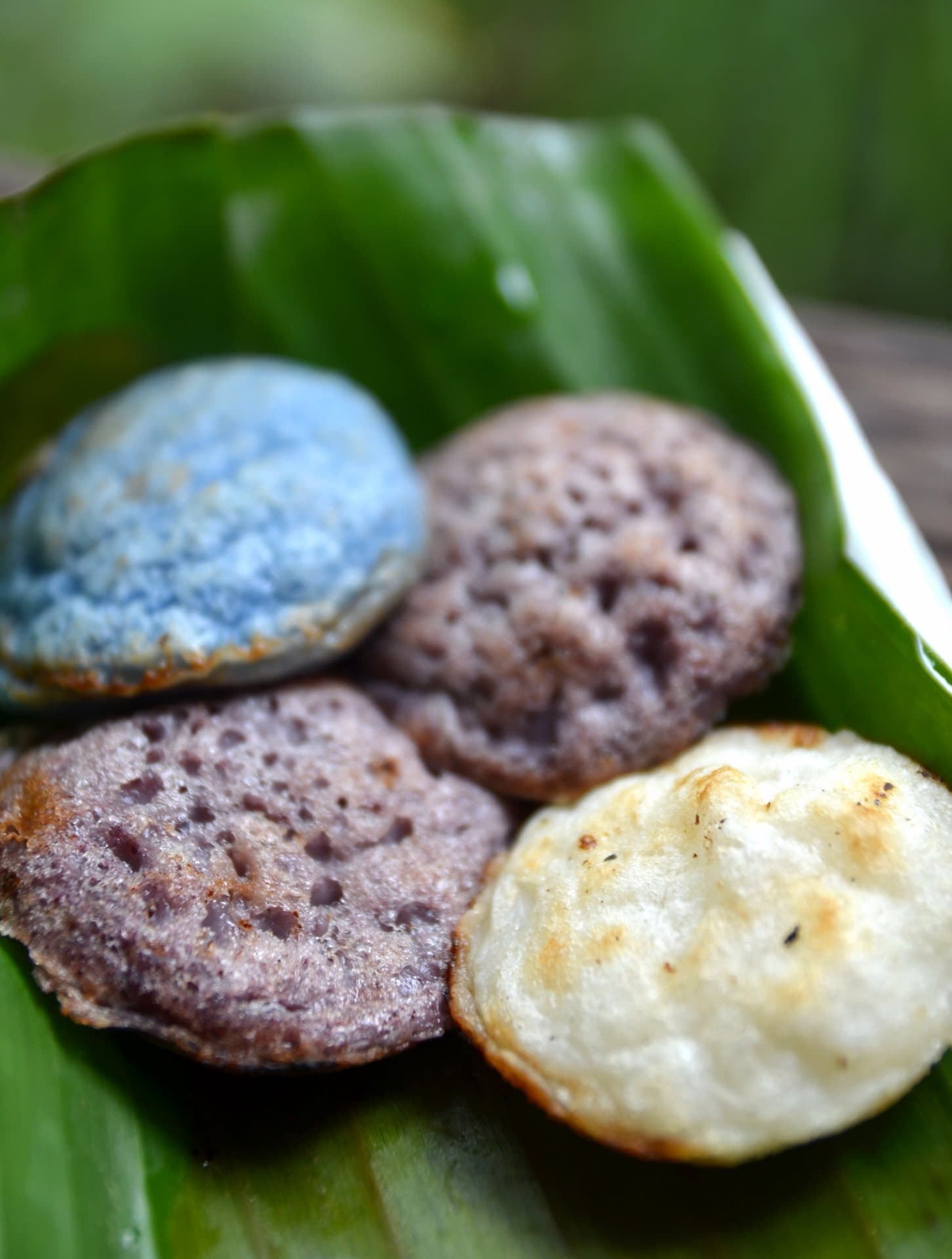
Tip · Buy from the stall that is cooking, not the one with a tray of finished food. Point at what you want and say "nueng chut" (one set). Most snacks are 20 to 40 baht.
Most visitors eat pad thai, green curry and mango sticky rice for two weeks and go home thinking they've had Thai food. The stuff Thais actually eat between meals is sitting on carts they walked past every day, and nobody stopped because there was no English sign and no obvious way to order.
This page is a running list of that food. One snack at a time, with what it is, what it should cost, where you'll find it and the few words that get it into your hands. It grows as I add to it. The first entry is khanom krok, because it's cheap, it's everywhere, and it's the one I'd send a first-timer to before anything else.
How buying from a cart works
The whole process is pointing. Walk up, point at what you want, hold up fingers for how many. Nobody expects you to speak Thai and nobody minds that you don't. If you want to try, "ao an nee" (I'll take this one) and "nueng chut" (one set) or "nueng thung" (one bag) cover almost everything on this page.
Pay in cash, small notes. A 1,000 baht note for a 25 baht snack is a small nuisance for the vendor and they'll sometimes have to go and find change. Twenties, fifties and coins are what you want in your pocket.
One rule matters more than the rest, and it applies to everything below: buy from the stall that is cooking, not the one with a tray of finished food sitting in the sun. Cooked-to-order food in Thailand is safe and good. The same food that's been sitting for two hours is neither. If a cart has a queue of Thais and the pan is going, that's the one.
Timing is the other thing people get wrong. Street food runs on two shifts, roughly 6 to 9 in the morning and again from about 4pm until the vendor sells out. The middle of the day is dead. Morning is when you'll see most of the sweet snacks, sold to people on the way to work and to kids on the way to school.
Khanom krok (ขนมครก)
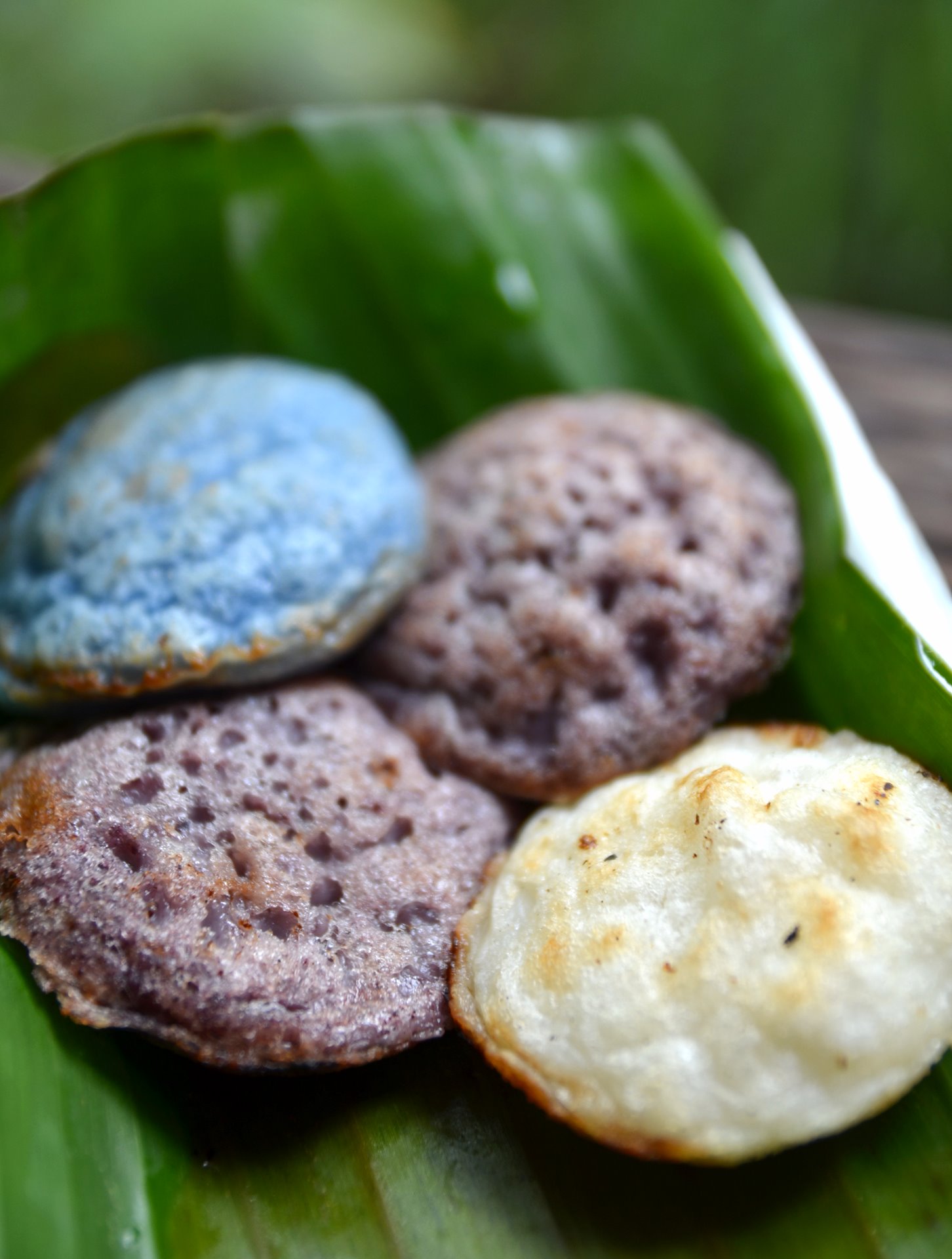
Khanom krok, plain and pandan. Photo by Takeaway, CC BY-SA 3.0.
Khanom krok are small coconut pancakes, crisp at the edge and soft in the middle, cooked in a heavy cast-iron pan with round dimples in it. "Krok" is the Thai word for mortar, which is what the dimples look like. It's pronounced roughly "ka-nom krok", with krok rhyming with clock.
There are two batters and that's what makes them. The first, rice flour and coconut milk with a little salt, goes into the hot dimple and starts to set with a crisp bottom. Then a spoon of thick, sweet coconut cream goes on top and cooks into a custard. The finished thing is half crunchy, half soft, sweet and slightly salty at the same time. A few strands of spring onion on top is the classic version. Corn, taro and pumpkin are the common variants, and you'll sometimes see a green pandan batter.
They're sold in a set, usually eight to ten pieces, either as open halves or stuck together in pairs. A set runs 20 to 40 baht depending on where you are. Anything above that is a tourist price. The vendor will scoop them out of the pan, drop them into a paper cup or a folded banana leaf, and hand them over hot. Eat them within a few minutes. The crisp rim goes soft fast, and khanom krok that have been sitting are a different, worse snack.
You'll find them at morning markets, outside BTS and MRT stations from about 6:30am, and at the local evening markets from late afternoon. Most of the carts are a woman with one pan on a gas ring, and she'll be doing one set at a time as people arrive. If you see a pan with the two batters going, stop. If you see a tray of finished khanom krok sitting under cling film at a tourist night market, keep walking.
Ordering is one line. "Khanom krok nueng chut" gets you one set. If they ask something back, they're asking whether you want the spring onion ("ton hom") or which topping. Nodding gets you the default, which is the one you want the first time anyway.
Don't confuse them with khanom buang, the crisp taco-shaped crepes with meringue in them, or khanom Tokyo, the small rolled pancakes with a sausage inside. All three show up on the same streets. Khanom krok is the round one from the dimpled pan, and in my opinion the best of the three.
Related reading
The night markets in Bangkok are where you'll see the widest spread of this food in one place. The Bangkok night markets guide covers which ones are still worth going to and when to arrive so the good stalls haven't sold out. If you're eating meat-free, the vegetarian phrases guide has the two words that matter at any stall. Khanom krok is usually fine, but ask about the fish sauce on anything savoury.