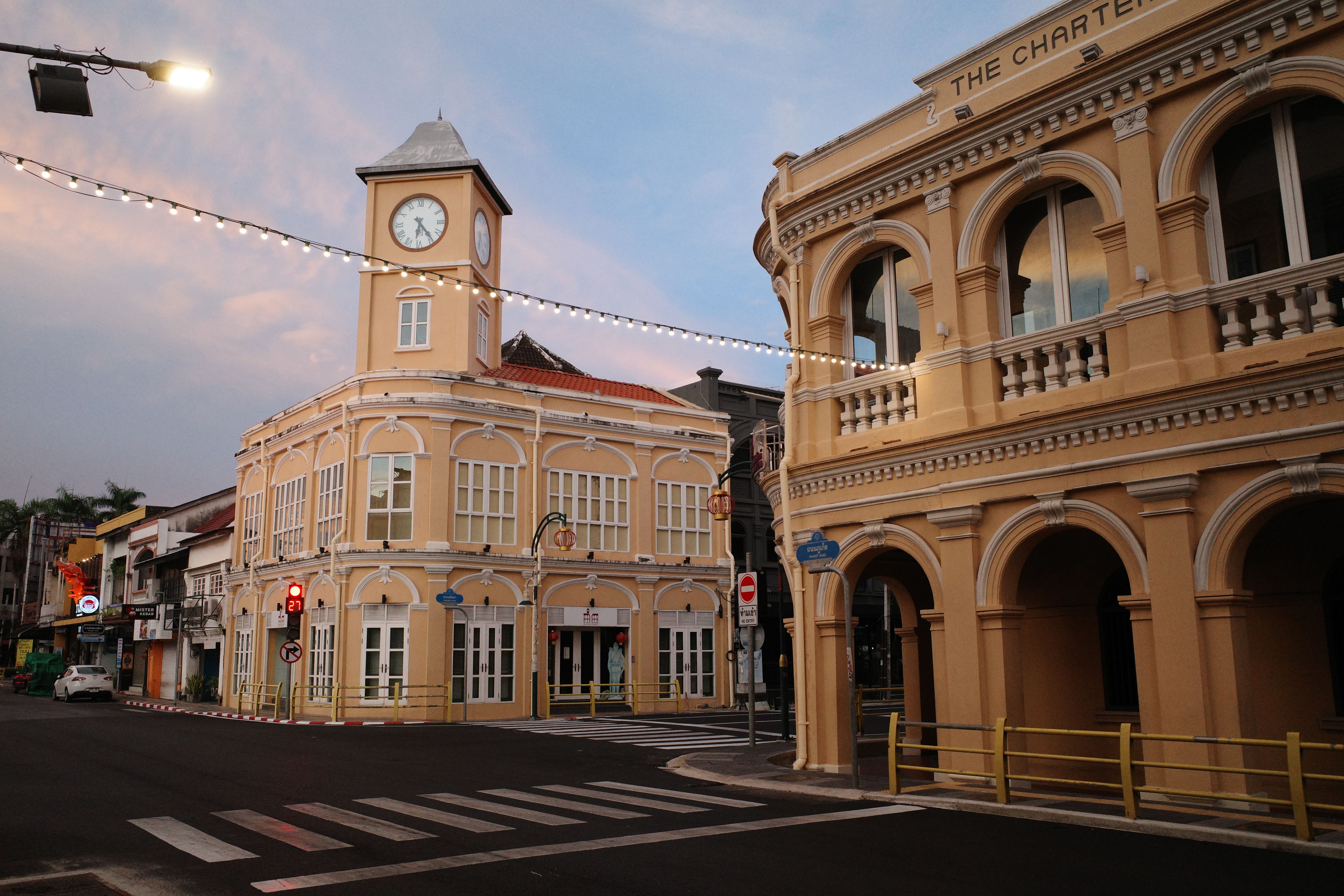
Phuket is Thailand's largest island, on the Andaman coast in the south of the country. It is joined to the mainland by the Sarasin Bridge, so it is reached by road as well as by air and sea. At roughly 540 square kilometres it functions more like a small province than a single resort: it has its own international airport, a provincial capital, hospitals and shopping malls, and a chain of west-coast beaches that each have a distinct character.
Most visitors base themselves on the west coast, where the beaches face the Andaman Sea, and travel out from there to the islands of Phang Nga Bay and the Phi Phi group. The east side of the island holds the airport, the passenger piers, and Phuket Town, the historic centre.
Getting there
Bangkok is the usual gateway. Almost all visitors reach Phuket by air; the island is also connected to the rest of the south by road and, in the dry season, by ferry.
From Bangkok
Flight
1h 25mDirect flights run throughout the day from both Bangkok airports, Suvarnabhumi (BKK) and Don Mueang (DMK), to Phuket International Airport (HKT). Carriers include Thai Airways, Bangkok Airways, Thai AirAsia, Nok Air, and Thai Lion Air. This is how the large majority of visitors arrive.
Check schedules on 12Go →Bus
12–13hOvernight coaches leave Bangkok's Southern Bus Terminal (Sai Tai Mai) and cross the Sarasin Bridge onto the island, arriving at the bus terminal in Phuket Town. The cheapest option, but a long journey.
Check schedules on 12Go →Train + bus
~15hThere is no railway to Phuket. The nearest station is Surat Thani on the southern line; from there it is roughly 5 hours onward by bus or minivan to the island.
Check schedules on 12Go →
Phuket International Airport also receives direct flights from many Asian and Middle Eastern hubs, plus seasonal routes from Europe and Australia, so a large share of visitors arrive without passing through Bangkok at all.
Airport transfer · The airport sits at the northern end of the island, about 30–60 minutes from the main west-coast beaches depending on which one. Official metered taxis, shared airport minibuses, and app-based cars (Grab, Bolt, inDrive) all operate from the terminal, with ride-hailing pickups made from a designated area.
Weather by season
Phuket runs on the southwest-monsoon calendar, the opposite of the Gulf islands such as Koh Samui. The year divides into a dry season from roughly November to April and a wet season from May to October. Temperatures are steady all year, in the high 20s Celsius.
Year-round climate
Jan
Feb
Mar
Apr
May
Jun
Jul
Aug
Sep
Oct
Nov
Dec
Conditions by month
Seasonal averages for the Andaman coast. Tap through to the monthly weather guide for detail.
Dry season
Nov–AprThe driest, calmest, and busiest half of the year, with the clearest seas for boat trips and diving. December to February is the peak, carrying the highest prices and the most reliable sunshine.
Hot months
Mar–AprThe tail of the dry season and the hottest part of the year, with rising humidity and the first afternoon showers appearing by April.
Green season
May–OctThe southwest monsoon brings heavier rain, usually in bursts rather than all day, and rougher surf on the west coast. Prices fall and the island is quieter. Coloured beach flags indicate rip-current conditions and should be observed.
Trip planner
Planning Phuket? See which days suit it.
The free trip planner shows the seasonal weather verdict for Phuket on your dates, how long it takes to get there from your other stops, and where to book.
Where to stay
Where to stay
Where to stay in Phuket
The beaches run down the west coast; the historic town sits inland on the east. Tap an area to see where it is and a few hotels at each price level.
Bang Tao & Surin
Northern west coastBest for: Upmarket resorts and a quieter, spread-out coast
A stretch of northern west-coast beaches holding many of the island's higher-end resorts, including the Laguna complex, along with the Boat Avenue and Porto de Phuket dining and shopping areas at Cherngtalay. Quieter and more spread out than the central beaches.
On the map
- Laguna & Boat Avenue
- Surin Beach
Hotels to shortlist
Banyan Tree Phuket Splurge
Lagoon villas inside the Laguna complex.
Angsana Laguna Phuket Mid-range
Large family resort on Bang Tao beach.
OZO Phuket Budget
Newer, well-rated, short walk from the sand.
Agoda · Affiliate link
Getting around
Phuket has limited public transport. Local songthaew routes (converted pickup trucks) connect Phuket Town with the main beaches but are slow and mostly stop in the early evening; there is no rail or metro on the island.
App-based ride-hailing (Grab, Bolt, inDrive) operates island-wide and is the most straightforward option for visitors, though fares are higher than in Bangkok. Metered taxis and tuk-tuks are also available, usually at fixed, negotiated prices. Because the beaches are spread out, many visitors rent a scooter or car to move between them; traffic on the main roads is faster and heavier than on the smaller islands.
Things to do
- West-coast beaches. The chain of beaches from Bang Tao in the north to Nai Harn in the south, each with a different character and level of development.
- Phang Nga Bay. The bay of limestone karsts north of the island, including the outcrop known as James Bond Island, reached on day trips that often include sea-cave kayaking.
- Phi Phi Islands. A group of islands to the southeast, including Maya Bay, visited on full-day speedboat tours for snorkelling and swimming.
- Similan Islands. A national marine park to the north known for diving and snorkelling, open roughly mid-October to mid-May.
- Phuket Old Town. The Sino-Portuguese historic quarter, with shophouse architecture, cafes, street art, and the Sunday Walking Street market.
- Big Buddha & temples. The 45-metre Big Buddha on Nakkerd Hill and Wat Chalong, the island's largest temple, are among the main cultural sites.
Local character & practical notes
Phuket has a distinct heritage rooted in 19th-century tin mining and Hokkien Chinese settlement, visible in the Old Town's architecture and in local dishes such as Hokkien mee, moo hong (braised pork belly), and a local style of dim sum eaten at breakfast.
The island holds the annual Phuket Vegetarian Festival (the Nine Emperor Gods Festival) over nine days in September or October, marked by processions and temple rituals. As across Thailand, modest dress covering shoulders and knees is expected at temples.
The west-coast beaches face open sea. During the monsoon, rip currents can be dangerous, and the coloured flags posted on the beaches indicate current conditions.
Going deeper
Opinion & first-hand guides to Phuket
This page keeps to the facts. For recommendations and first-hand takes, these blog posts go further.