Tip · Take the train, not the tour bus. The 07:50 rapid from Krung Thep Aphiwat costs about 20 baht in third class, takes a little over an hour, and gets you to the ruins before the coach groups.
Skip the tour bus and take the train to Ayutthaya. A little over an hour north of Bangkok on a 20-baht ticket, the city that was the capital of Siam for four hundred years sits in ruins along a loop of the Chao Phraya: brick chedis, decapitated Buddhas, the brick walls of palaces that the Burmese army burned down in 1767. Of all the day trips from Bangkok, it's the one I'd do first.
Why Ayutthaya is worth a day
Ayutthaya was the capital of Siam from 1351 until 1767. At its peak in the 1600s it was one of the largest cities in the world, with a cosmopolitan population of Thais, Chinese, Persians, Portuguese, Dutch, and French traders. Then a Burmese army sacked it, burned it to the ground, and the capital moved south to what eventually became Bangkok.
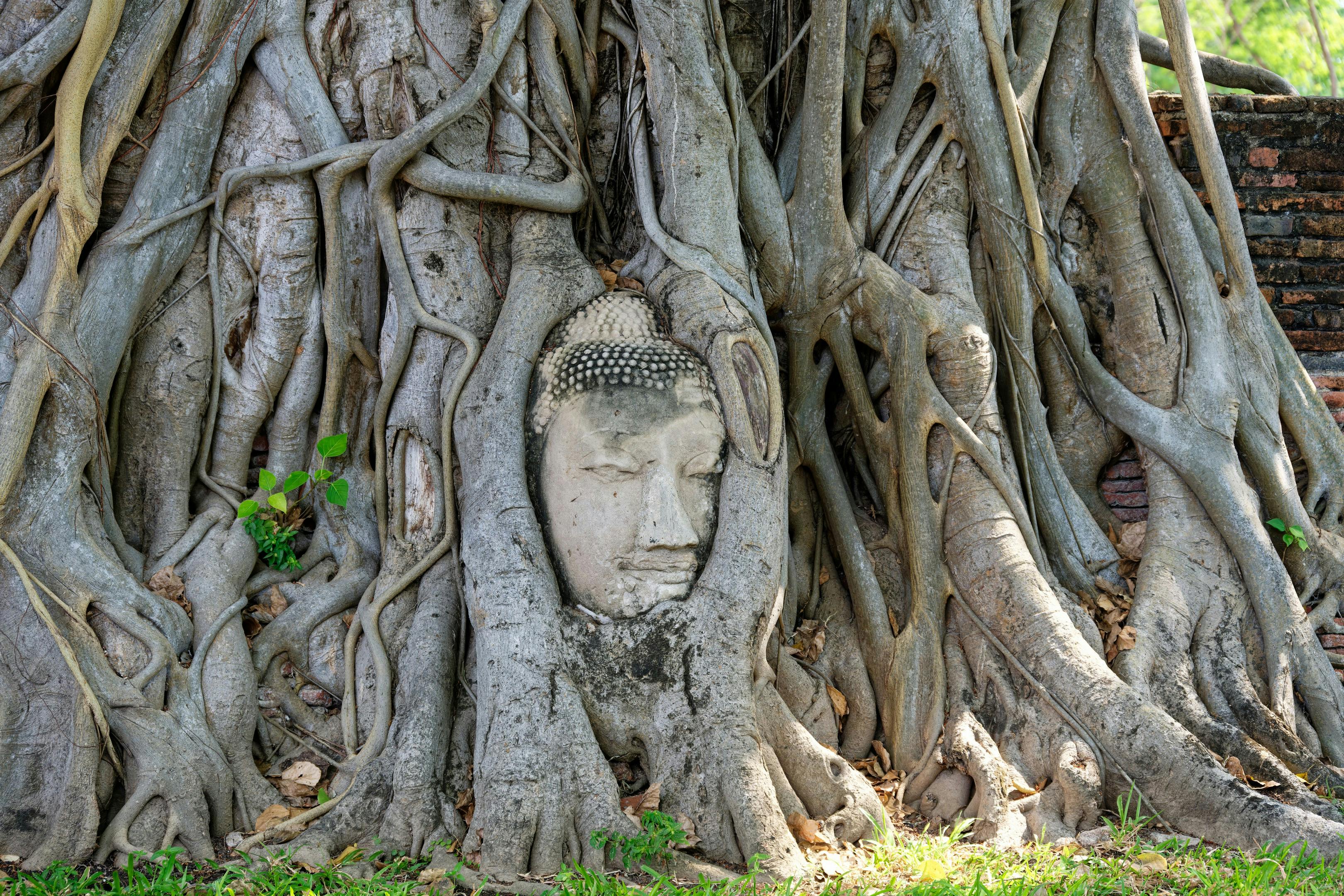
What's left is a compact historical park on an island formed by three converging rivers, with three sights you'll recognise from every photo of the place: the Buddha head wrapped in fig-tree roots at Wat Mahathat, the three chedis of Wat Phra Si Sanphet, and Wat Chaiwatthanaram at sunset. The whole thing is a UNESCO World Heritage site, and there are still working monasteries scattered between the ruins, so people live and worship around them.
A day is enough to see the highlights. An overnight lets you be at the first gate when it opens at 8am, before the day-trip coaches, and actually slow down between temples.
How to get to Ayutthaya from Bangkok
Ayutthaya sits 80km north of Bangkok. These are the ways up, one way, as of October 2026:
| Option | Leaves from | Time | Cost | My take |
|---|---|---|---|---|
| Rapid train, 3rd class | Krung Thep Aphiwat | 65–80 min | about 20 baht | The one I'd take. The 07:10 or 07:50 beats the tour coaches |
| Bangkok Connex (air-con) | Krung Thep Aphiwat | about 75 min | 50 baht until 31 Oct 2026 | New since August, possibly weekends only. Tickets at the station only |
| Ordinary train, 3rd class | Hua Lamphong | about 2 hours | 15–20 baht | The first one after dawn is 10:15. Too late for an early start |
| Express, 2nd class air-con | Krung Thep Aphiwat | about 1 hour | 245–345 baht | Reserved seat, comfortable, a lot of money for 80km |
| Minivan | Mo Chit 2 van terminal | 90 min to 2.5 hours | 70–100 baht at the counter, about 150 online | Leaves when full, traffic decides the rest |
| Grab | Your hotel | 75–90 min | 900–1,500 baht | Makes sense split three or four ways |
| Guided tour | Hotel pickup | Full day | More than all of the above | Everything handled, see below |
Train: the one I actually recommend
The State Railway runs four kinds of train up to Ayutthaya. My pick is a rapid train from Krung Thep Aphiwat, the big new station at Bang Sue (MRT Bang Sue on the Blue Line). The 07:10 or the 07:50 gets you into Ayutthaya around 8:30 to 9:00, before the tour coaches roll in, and third class is still about 20 baht.
Since August 2026 there's also the Bangkok Connex, an air-conditioned commuter train from the same station. The useful one is the 09:05, about 75 minutes, on an introductory fare of 50 baht that runs until 31 October. Nobody has said what it costs after that. Tickets are sold at the station only, not online. Timetables disagree on whether the 09:05 runs every day or only at weekends, so on a weekday I'd take the 07:50 rapid rather than count on it.
The cheap ordinary trains from Hua Lamphong, the old central station, still run, but they take two hours and the first one after dawn leaves at 10:15 (some timetables still say 09:30), getting in around midday. Fine for a lazy start, useless for beating the crowds. The express trains from Krung Thep Aphiwat are quick and comfortable, with reserved air-con seats, but you're paying more than ten times the fare to save a quarter of an hour.
You don't need to book ahead for third class or the Connex. Turn up, buy a ticket, get on. Times do shift, so check the board when you buy. Whichever train you take, get a window seat. It's rice fields and water buffalo most of the way.
The train drops you at Ayutthaya station on the east bank of the river, a short walk and a 5 to 10 baht ferry ride across to the island where the ruins are (a few baht more if you take a bike over). Hire a bicycle at one of the shops by the station or the ferry landing. Expect 50 to 100 baht for the day.
Getting back: the evening trains
If you stay for sunset (and you should), these are the trains back:
- Ordinary 210, around 6:20 to 6:50pm, back to Hua Lamphong, about 20 baht.
- Rapid 102, around 7pm, to Krung Thep Aphiwat in about an hour.
- Bangkok Connex, 7:45pm, to Krung Thep Aphiwat by 9pm. Timetables disagree on whether it runs every day, so check at the station.
- Special Express 22, around 9:20pm, the last train of the night. Air-con second class only, about 245 to 345 baht, reserved seats.
Leaving earlier? Rapid 136 passes through around 4:40pm and gets into Krung Thep Aphiwat around 6pm. Trains coming down from the north in the late afternoon and evening can run late, sometimes by an hour, so don't plan a tight connection in Bangkok.
Other ways up
The minivan only makes sense if you're staying near Mo Chit: you have to get out to the Mo Chit 2 van terminal first, and it's cramped with no view. A Grab is worth it split three or four ways, or if you want to stop at Bang Pa-In Royal Palace on the way (the late-1800s summer palace 20km south of Ayutthaya; pleasant, not unmissable). And if you'd rather not deal with any of it, a guided tour does the whole day for you. My pick is further down.
Book transport
Getting to Ayutthaya
Third class and the Connex are sold at the station on the day. For a reserved express seat or a minivan, 12Go shows what's running.
The temples actually worth your time
There are more than 400 historical sites scattered across the Ayutthaya area. You're not going to see them all, and you don't need to. The five below cover the highlights and give you a proper sense of the place.
Wat Mahathat: the Buddha head in the tree
The most photographed image in Ayutthaya: a sandstone Buddha head, probably toppled during the Burmese sack in 1767, that has slowly been embraced by the roots of a fig tree until the tree and the head are now part of the same sculpture. It sits at ground level near the entrance and there's a respectful etiquette: squat down so your own head is below the Buddha's while you look or take a photo. Park rangers will gently correct you if you don't.
The rest of the wat is worth a slow wander too. Broken chedis, the foundations of the central prang, rows of headless seated Buddhas along the old gallery walls.
Wat Phra Si Sanphet: the three chedis
The royal temple of the old palace, inside the historical park, and the postcard view of Ayutthaya: three intact bell-shaped chedis in a row, each holding the ashes of a different king. There were no monks here. It was strictly the king's chapel, the model for Wat Phra Kaew at the Grand Palace in Bangkok.
Go early or late to avoid the worst of the heat on the open ground. There's almost no shade.
Wat Chaiwatthanaram: for sunset
The one that justifies staying past 4pm. Wat Chaiwatthanaram sits on the west bank of the river, outside the main historical park, and the Khmer-style central prang surrounded by smaller chedis is at its best in the last hour of light. Ticket sales stop around 5pm and the gates close around 6pm, so get there by four or half past.
I keep going back for that last hour before sunset. If you want the brick turning copper, keep the sun behind you: stand on the west side of the grounds facing east, with the chedis in front of you and the river behind them. Face west instead and you get the prang as a dark outline against the sky. From about mid-October to the end of December the sun sets just before the 6pm closing. The rest of the year it goes down after the gates shut (as late as about 6:50pm in early July), so the hour before closing is what you're really there for.
Plan the trip back before you sit down. If you came over on a bicycle, Chaiwatthanaram is about 10 minutes' ride west of the island, but the bike still has to go back to the shop and you still have to get across to the station side, and the cross-river ferry reportedly stops around 5:30pm. The easier version: return the bike in the late afternoon, take a tuk-tuk out to Chaiwatthanaram, and have the same driver take you to the station afterwards.
A note: in recent years this has become the temple where Thai visitors come in rented traditional dress for photoshoots. You'll see groups of women in full Ayutthaya-era costume. It's a Thai fashion trend, and it adds to the atmosphere.
Wat Yai Chai Mongkhon: the big chedi and the reclining Buddha
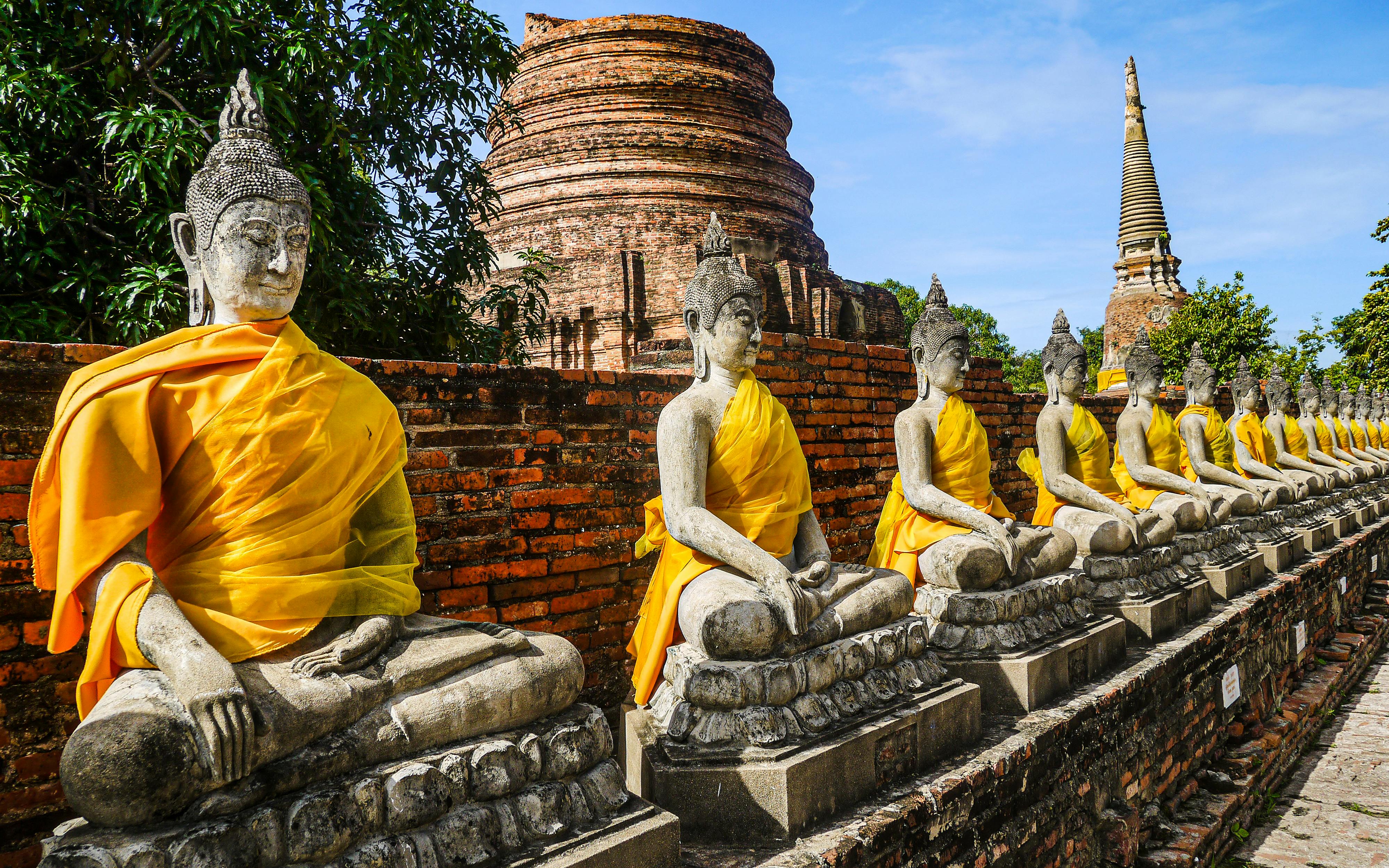
East of the island, a 10-minute tuk-tuk ride from the station. An enormous bell-shaped chedi you can climb, surrounded by rings of seated Buddhas in saffron robes, and a long white reclining Buddha in the grounds. Still a working monastery, so monks are around. It charges its own small fee, 20 to 40 baht, and closes around 5pm. It's on the station side of the river, so go straight from the morning train or on your way back in the afternoon. Worth the detour off the island.
Wat Lokayasutharam: the giant outdoor reclining Buddha
A simple stop: a reclining Buddha about 40 metres long, in the open air, with the rest of the temple long gone around it. Free, takes 10 minutes, on the way between the other island temples. Easy add to a bicycle loop.
Getting around the historical park
The ruins are spread over an island roughly 3km across. Most independent visitors hire a bicycle, and it's what I'd do: the ground is flat, the distances are short, and you can stop whenever something catches your eye. Bring water, because it gets hot. If you'd rather sit in the breeze and let someone else navigate, a tuk-tuk costs 200 to 300 baht an hour, and three hours covers the headline temples. Walking works for the cluster in the centre of the island (Mahathat, Phra Si Sanphet, the museum), but you'll wish you hadn't for the outer ones.
What it costs, and what to wear
The DIY version of this day is cheap. A rough budget, before food:
| Item | Cost |
|---|---|
| Train up and back | 40 baht in third class both ways, up to 100 on the Connex (promo fare until 31 Oct) |
| Ferry and bicycle | 60 to 110 baht |
| Three Fine Arts temples | 150 to 240 baht |
| Wat Yai Chai Mongkhon | 20 to 40 baht |
| Tuk-tuk for the evening (out to Chaiwatthanaram, wait, then the station) | 400 to 600 baht, about two hours at 200 to 300 an hour |
Without the tuk-tuk, call it 300 to 500 baht for the day. The tuk-tuk is per vehicle, not per person, so it gets cheap fast split two or three ways.
Temple tickets. The main ruins (Mahathat, Phra Si Sanphet, Ratchaburana, Chaiwatthanaram and a few smaller ones) are run by the Fine Arts Department. Its own page still says 50 baht a site, but people visiting this year report paying 80 after a 2025 fee rise for foreigners, so budget 80. For the five temples in this guide, only three are Fine Arts sites, so at 80 baht a site, paying at each gate (240 baht) beats the combined ticket, which visitors report at 300 baht for seven sites. It only pays off if you add Wat Ratchaburana and the smaller ruins. (Under the old 50-baht fees it was 220 for six.) These sites open roughly 8am to 6pm, with tickets sold until about 5pm. The working temples (Wat Yai Chai Mongkhon, Wat Phanan Choeng) charge their own small fees, and Wat Lokayasutharam is free.
What to wear. Signs at the official sites ban shorts, mini skirts, tank tops and crop tops, and at the working temples you should cover your shoulders and knees anyway. Light long trousers or a long skirt and a T-shirt solve both, and you'll want the cotton in that heat.
The guided-tour option
If you want to do Ayutthaya in a single day without doing the planning yourself, and especially if you want someone to explain the history as you go, a guided day tour from Bangkok is the easy answer. Pickup from your hotel, an English-speaking guide who can actually tell you what you're looking at, lunch and entry fees handled, dropped back in the evening. The cost premium over the train is real, but you skip all the logistics.
The tour below covers the main temples (Wat Mahathat, Wat Phra Si Sanphet, Wat Chaiwatthanaram) and includes lunch.
Photos, price and reviews for this tour load from GetYourGuide, which sets its own cookies.
The honest "skip this" notes
A few of the things you'll see pushed in Ayutthaya that aren't worth your time or money.
Elephant rides. Elephants still carry tourists around the ruins near the historical park. Skip it. Carrying people is hard on an elephant's back, and the training that gets them to accept riders is cruel. If you want to see elephants, a sanctuary where nobody rides them is the better day out.
The Bangkok-to-Ayutthaya river cruise day packages. The big package boats that motor up the Chao Phraya from Bangkok with a buffet lunch and a brief Ayutthaya stop sound romantic and are mostly a long buffet lunch on the river with two hours of rushed sightseeing tacked on. Skip them. If you want time on the water, a small longtail-boat loop around the Ayutthaya island in the late afternoon gives you the river and the temples from the water without losing the day.
Doing all 400 sites. You can't and you shouldn't. Pick five or six, take them slowly, sit in the shade between them, eat boat noodles for lunch.
What to eat
The local specialty is Ayutthaya boat noodles: small, intense bowls of dark beef or pork broth with noodles, originally sold from boats along the canals. Stalls cluster near the markets in the centre of the island; order three or four bowls at a time, because that's how it's done.
The other one to try is roti sai mai, pastel-coloured candy floss wrapped in thin crêpes, an Ayutthaya invention. The place to buy it is U Thong Road opposite the Phra Nakhon Si Ayutthaya Hospital, where the shops sit almost door to door; Roti Sai Mai Abeedeen there has been run by the same family for more than 70 years. It's not going to change your life but it's the local thing.
That's Ayutthaya. Take the morning train, cycle the ruins, watch the light go at Wat Chaiwatthanaram, and be back in Bangkok in time for a late dinner at one of the Yaowarat street-food stalls. If this is your first trip to Thailand, our first trip to Thailand checklist covers what to sort before you fly, and the Bangkok neighbourhood guide covers where to base yourself for these kinds of day trips.
Common questions about Ayutthaya
Can I wear shorts in Ayutthaya? Signs at the official ruins say no shorts, mini skirts or tank tops, so bring light long trousers or a long skirt.
What time is the last train back to Bangkok? The Special Express 22, around 9:20pm, is the last one. Most people stay for sunset and take the Rapid 102 around 7pm or the Connex at 7:45pm (check at the station that it runs that day).
Is one day enough? For the highlights, yes. Stay overnight if you want to be at the first temple when the gates open at 8am, before the coaches, or a slower day with long breaks in the shade.
Do I need a tour? No. The train, a ferry and a bicycle get you everywhere on the island. A tour is worth it if you want hotel pickup and a guide who explains what you're looking at.
More detail:
Trip planner
Planning Ayutthaya? See which days suit it.
The free trip planner shows the seasonal weather verdict for Ayutthaya on your dates, how long it takes to get there from your other stops, and where to book.