Tip · Base yourself in Hua Hin for the food and the transport links, then give Prachuap Khiri Khan a full day of its own. Skip the themed 'parks' near Hua Hin unless you're travelling with kids.
Hua Hin was Thailand's first beach resort, and most foreign visitors have never heard of it. They land in Bangkok, transfer to a flight or a ferry, and go straight to the islands. The whole western shore of the Gulf, three or four hours south of Bangkok by road, gets written off as the place Thai families go on long weekends. That's exactly what it is and what makes these places so great.
This stretch of coast runs roughly north to south through three towns that are easy to see together. Cha-Am is the first you reach, a flat beach town that lives off Bangkok weekenders. Hua Hin is next, the largest and most developed, with the royal connections, the markets, and the golf. Then the coast quiets down again as you carry on south to Prachuap Khiri Khan, a small provincial capital wrapped around a bay, with monkeys on the hill and some of the best cheap seafood in the country. None of them are tropical-island beautiful. The sand is darker, the water flatter, the scenery gentler. What you get instead is a part of Thailand that isn't performing for tourists.
Getting there
The easiest way down is by road. Minivans and buses leave Bangkok's Southern Bus Terminal (Sai Tai Mai) through the day, and the ride to Hua Hin takes around 3 to 3.5 hours depending on traffic getting out of the city. A van seat is roughly 180 THB. If you'd rather not deal with the terminal, a Grab or a private car from central Bangkok covers the same drive in similar time for a lot more money.
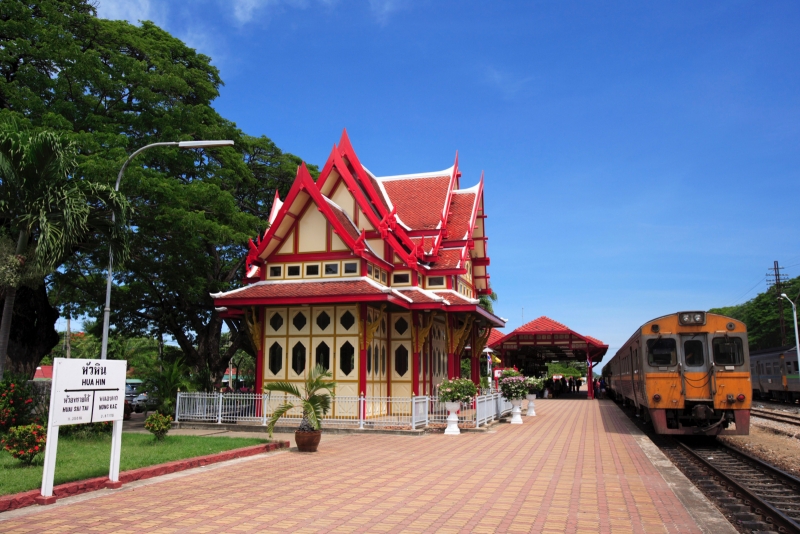
The train is the better story and the slower option. Hua Hin sits on the southern railway line, and the station itself is one of the reasons people come: a red-and-cream wooden building with a royal waiting room pavilion that has been photographed about a million times. The trip from Bangkok takes around 4 hours and costs very little. It's worth doing once for the ride and the arrival, less worth it if you're short on time. The same line carries on south, so you can take a local train from Hua Hin down to Prachuap Khiri Khan in about 1.5 hours.
Cha-Am is 25 minutes north of Hua Hin and shares the same buses and trains. Prachuap is about 90 km further south, roughly 1.5 hours by car or train.
Book transport
Getting to the upper Gulf coast
Compare schedules and prices on 12Go.
Popular routes
- Bangkok → Hua HinVan · 3.5h
- Bangkok → Hua HinTrain · 4h
- Bangkok → Cha AmBus · 3h
- Hua Hin → Prachuap Khiri KhanTrain · 1.5h
Powered by 12Go · Affiliate link
Cha-Am
Cha-Am is where Bangkok goes when it wants the beach without the drive to the islands. The beach is long, flat, and lined with deck chairs, umbrellas, and vendors selling grilled squid and som tam straight to your seat. Midweek it's close to empty. On a weekend it fills with Thai families, banana boats, and inflatable rings, and the whole place runs at the relaxed, slightly chaotic pace of a domestic holiday. There is very little here aimed at foreign tourists, which is the appeal. You won't find much English and you won't be hassled.
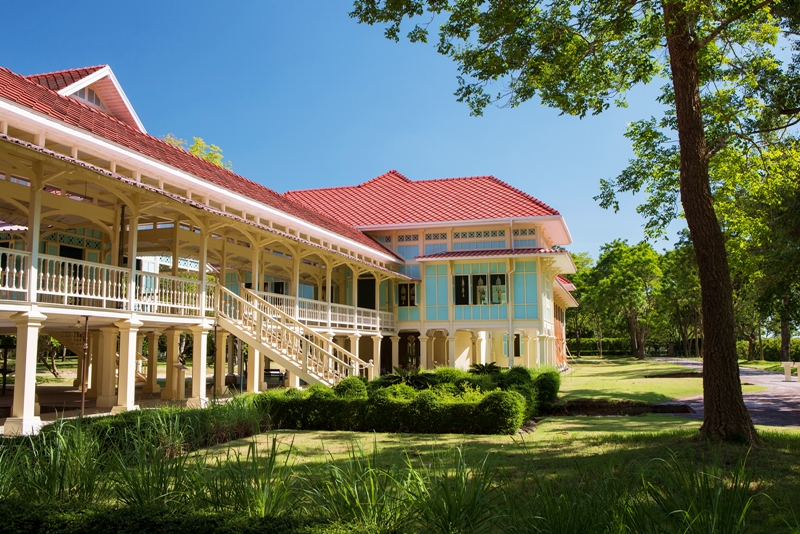
The thing actually worth stopping for sits between Cha-Am and Hua Hin: Maruekhathaiyawan Palace. It's a teakwood summer palace built for King Rama VI in the 1920s, raised on stilts and designed so the sea breeze moves straight through it. Long open corridors, pale wood, almost no walls in the usual sense. It's quiet, it's cheap to enter, and most people drive past without knowing it's there. Dress modestly, since it sits on a military base and that's a condition of visiting.
If you're choosing between Cha-Am and Hua Hin as a base, Cha-Am is the cheaper, plainer, more local option. Most foreign visitors will be happier in Hua Hin, but a night in Cha-Am tells you what a Thai beach weekend actually looks like.
Hua Hin
Hua Hin is the centre of gravity for this coast. The Thai royal family has kept a summer residence here since the 1920s, the palace name Klai Kangwon translates to "far from worries," and that royal association is still what gives the town its character. It's comfortable, well-off, and a little staid compared with the islands. There are no full moon parties here. The crowd skews toward families, golfers, retirees, and Bangkok couples down for the weekend.
The main beach is wide and walkable, with horses for hire at the northern end near the old fishing pier. It isn't a great swimming beach by Thai standards, but it's pleasant for a morning walk. At the southern end the beach runs into Khao Takiab, a hill locals call Monkey Mountain, with a temple and a large standing Buddha on top and a resident troop of macaques that have learned tourists carry food. Don't bring any up with you, and don't make eye contact while holding a bag. They will take it.
What Hua Hin really does well is markets. The Hua Hin Night Market on Dechanuchit Road in the centre of town is the classic one: seafood laid out on ice, point-and-grill stalls, and the usual market clothes and souvenirs. Out toward Khao Takiab, the Cicada Market runs Friday to Sunday evenings and leans more toward art, crafts, and live music, with a food section next door at Tamarind Market. Cicada is more polished and more aimed at visitors, but it's a good evening.
You'll also notice Hua Hin is full of European-styled theme attractions: a fake Venice with canals, a Santorini park, a Swiss sheep farm. These are built for the Thai and Chinese photo-trip market and I'd skip them unless you're travelling with children, in which case the water parks are genuinely good. Hua Hin is also one of Thailand's main golf destinations, with several well-regarded courses in the hills behind town, so if you play, this is a reason to come.
Prachuap Khiri Khan
Prachuap Khiri Khan is the one most people have never heard of, and it's my favourite of the three. It's a small provincial capital built around a curving bay, with a seafront promenade, fishing boats moored offshore, and a row of seafood restaurants looking out at the water. There is almost nothing here engineered for tourism. People come to eat, walk the bay in the evening, and not much else, which is the point.
The landmark is Khao Chong Krachok, a hill rising straight out of town with a temple at the top. You climb 396 steps to get there, past a large troop of monkeys that are every bit as pushy as the ones at Khao Takiab, and the reward is a clean view over the whole bay and the islands offshore. Carry nothing loose and you'll be fine.
A few kilometres south is Ao Manao, a long clean beach that sits inside a Royal Thai Air Force base. You drive through the gate, sign in, and use a beach that's quieter and better for swimming than anything in town. It was also one of the spots where Thai forces fought the Japanese landings in December 1941, and there are small memorials to that. North of town, Ao Noi is a quieter fishing bay if you want to go further still.
Prachuap is a town to slow down in rather than tick off. A night here, a seafood dinner on the bay, and the climb up the hill in the morning is about the right shape for it.
Sam Roi Yot and Phraya Nakhon Cave
The single best thing on this coast sits between Hua Hin and Prachuap: Khao Sam Roi Yot National Park, a range of limestone peaks rising out of marshland and shrimp farms. The reason to come is Phraya Nakhon Cave. You reach it from the fishing village of Bang Pu, either by a short longtail boat ride or a steep walk over a headland, and then climb up into the hills to the cave itself.
Inside, a sinkhole has collapsed the cave roof, and a small ornate pavilion sits on the floor of the chamber. It was built for a royal visit by King Rama V. On a clear morning a shaft of sunlight drops through the opening and lights the pavilion directly, usually around 10 to 10:30am. It's the kind of thing that's hard to picture from a description and obvious the moment you're standing there. Go in the morning, both for the light and because the climb is hot by midday. Bring water and proper shoes. This is the trip to organise if you do nothing else active on this coast.
Where to base yourself
For most people the answer is Hua Hin. It has the widest choice of hotels at every price level, the best food and markets, the easiest transport links, and it's central to everything else, including day trips north to Cha-Am and south to Sam Roi Yot. Treat it as your base and you can see the whole coast without moving hotels.
Cha-Am makes sense if you want somewhere cheaper and more straightforwardly Thai, and you don't need much beyond a beach and a deck chair. Prachuap Khiri Khan is worth a night in its own right rather than as a base, since it's far enough south that day-tripping back and forth eats the day. The ideal version of this trip, if you have the time, is two or three nights in Hua Hin and one in Prachuap, with Sam Roi Yot done on the drive between them.
Food
This coast eats well, and it eats cheaply once you get off the obvious tourist strips. Seafood is the thing: this is a working fishing coast, and the catch is local rather than trucked in. In Prachuap the row of restaurants along the bay serve it about as fresh and as cheap as you'll find anywhere in Thailand, with most menus still in Thai. In Hua Hin the night market is the easy option, though you pay a small tourist premium there. For better value, the morning market (Chatchai Market) in the centre of town is where locals actually shop and eat breakfast.
The general rule holds everywhere down here: the further you get from the beachfront and the deck chairs, the better and cheaper the food gets. A plate of curry over rice at a shop with no English menu and a few trays under glass will run you 50 to 70 THB and beat most of what's on the seafront.
Best time to go
The upper Gulf coast is driest and most reliable from roughly December to April, with the cooler, calmer weather running through the early part of that window. This is the western edge of the Gulf, so its rhythm is closer to Bangkok's than to the southern Gulf islands. The wettest stretch tends to be September and October, when storms come up the coast, though the rain here usually falls in bursts rather than all day.
Weekends are the other thing to plan around. Because this whole coast lives off Bangkok, Hua Hin and Cha-Am fill up Friday to Sunday and empty out midweek. If you can come Monday to Thursday, you'll find it cheaper and far quieter. For how this fits into a longer trip, the best time to visit Thailand guide walks through the full calendar.
This coast isn't going to compete with the islands on scenery, and it isn't trying to. What it offers is an easy, unhurried slice of Thailand that most foreign visitors never see, close enough to Bangkok that there's no excuse not to. If you're putting the rest of the trip together, the first trip to Thailand checklist covers what to sort before you fly.