Tip · Book the overnight train from Bangkok as soon as berths open, 90 days ahead. Sleeper berths sell out fast, and the train ride itself is half the appeal.
After a few days in Bangkok, Chiang Mai is what Thailand looks like when it slows down. The traffic eases. The skyline drops. The streets are walkable and the temples are everywhere. If you spent your first stop figuring out where to stay in Bangkok, Chiang Mai is the easier puzzle: the centre of the action is a 1.5km square ringed by an old brick moat, and almost everything a first-time visitor wants to see is inside it or walking distance from it.
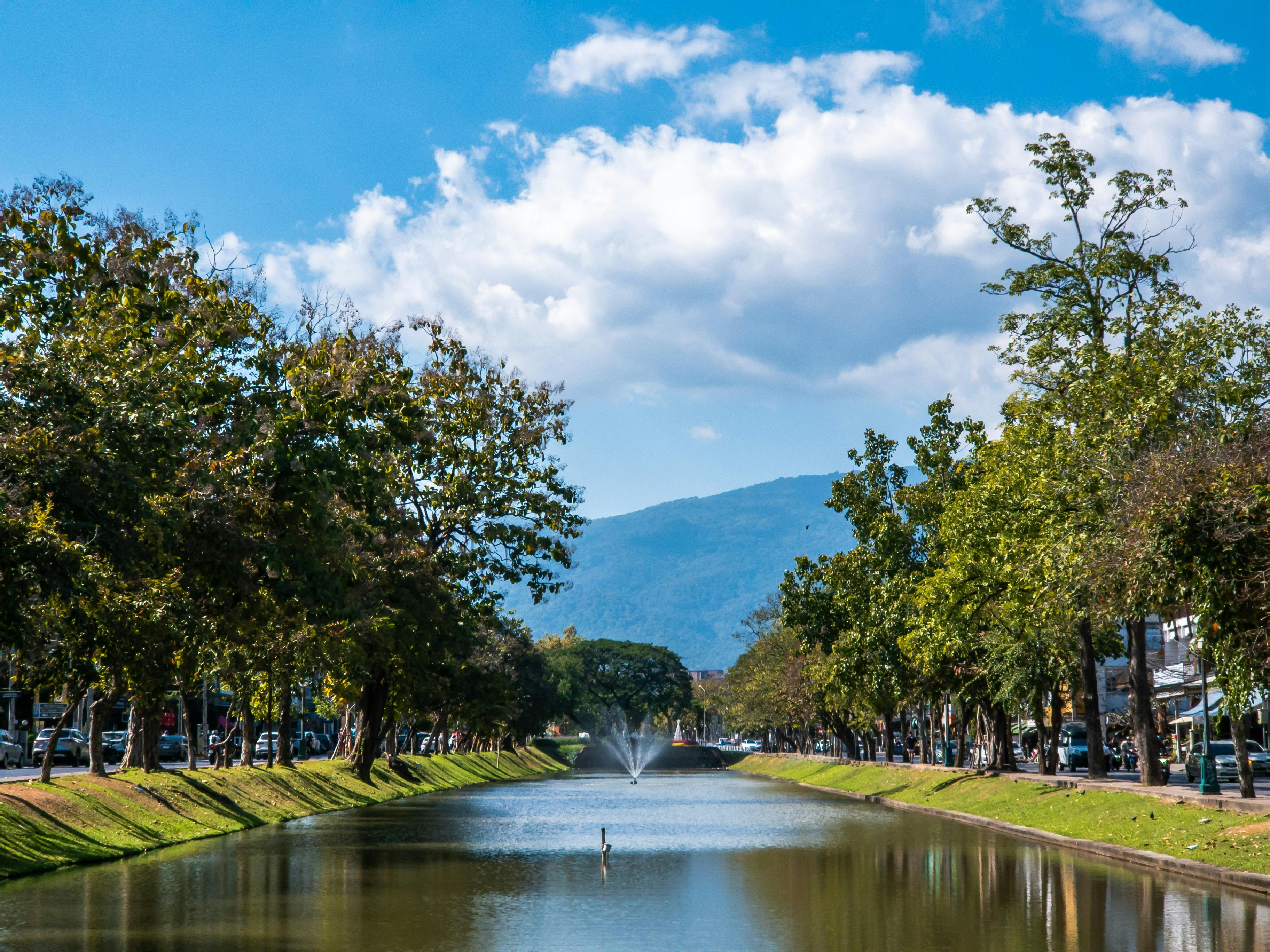
Chiang Mai is known for three things: temples (more than three hundred of them, give or take), the mountains that ring the city, and northern Thai food that you can't easily find further south. It's also the launching point for the rest of northern Thailand, with its coffee villages, Karen weaving cooperatives, and the wild forests that gibbons still live in. Most first-time visitors should stay inside the Old City; everything in this guide is either there or a short ride away.
Getting to Chiang Mai
Most travellers arrive from Bangkok. You have three real options.
Fly
The fastest and often cheapest way. Thai AirAsia, Nok Air, and Thai Vietjet all fly Bangkok → Chiang Mai several times a day, in about 1 hour 15 minutes. Booked a week or two ahead, fares run roughly 800–1,800 THB (around $25–55). Chiang Mai International Airport (CNX) is small and sits 10 minutes by Grab from the Old City. If you're short on holiday and want to maximise time on the ground, fly.
Take the overnight train
The Bangkok → Chiang Mai sleeper train is one of the genuine experiences of travelling in Thailand. You board at Krung Thep Aphiwat (the new main station, north of central Bangkok) in the evening, eat dinner at your seat as the city slides past, and wake up the next morning with the landscape turning into rice fields and hills. Second-class sleeper is the sweet spot: air-conditioned, curtained berths, around 900–1,200 THB.
The catch: the sleeper sells out. Berths open 90 days in advance (the State Railway cut it from 180 in April 2026) and the popular night departures go quickly, especially the lower berths (which are wider and more comfortable). If the overnight train is part of your plan, book it before you book anything else.
Take the bus
The night bus is cheaper than the train (roughly 600–900 THB) and slightly faster on paper (around 10 hours), but the experience is firmly in the "transport, not travel" category. Worth considering if the train is sold out and flights are pricey. Otherwise, skip.
Book transport
Getting to Chiang Mai
Compare schedules and operators on 12Go. Train berths open 90 days ahead and sell out well before that, so book early.
Popular routes
- Bangkok → Chiang MaiTrain · 13h
- Sukhothai → Chiang MaiBus · 5h
- Chiang Rai → Chiang MaiBus · 3h
- Pai → Chiang MaiMinivan · 3h
Powered by 12Go · Affiliate link
When to visit (and the season to avoid)
Chiang Mai has one stretch of the year I'd tell you to plan around, and it's got nothing to do with rain. Roughly late February through April, farmers across the north burn off their fields, the smoke settles into the valley the city sits in, and the air quality drops hard. March and early April are usually the worst of it. On the bad days you can't see Doi Suthep from the moat, which is strange when the whole point of the temple is that you can normally see it lit up from anywhere in town. If your dates are flexible and land in that window, check an air-quality app (IQAir is the one I use) before you commit, and know that some people are more sensitive to it than others.
The cool season, November to February, is the best time to be here. The evenings actually get cool, the skies are clear, and the Monk's Trail is comfortable rather than punishing. It's also the busy season, so book accommodation ahead. The green season, May to October, gets a bad reputation it doesn't fully deserve: the rain usually comes as a heavy afternoon downpour and then clears, everything is green, the air is clean, and there are far fewer tourists. If you don't mind getting caught in the occasional soaking, it's a fine time to come.
Songkran (April 13 to 15) sits right at the tail of burning season. The water fight is worth planning a whole trip around, and I've written about it below, but be honest with yourself about the haze if you're sensitive to it.
Getting around once you're here
The Old City is a 1.5km square and you can walk most of it, so for the temples and markets your feet are all you need.
For anything further, songthaews are the local option: the red shared pickup trucks that circle the city. Flag one down, tell the driver where you're going, and it's usually 30 to 40 THB per person for a hop around town. Agree the price before you climb in the back. Grab also works well in Chiang Mai, and unlike Phuket or Samui the pricing here is fair, so it's my default for the airport run or a trip out to Nimman. If you'd rather sort your rides the easy way, our Grab guide covers how it works.
Renting a scooter (around 200 to 250 THB a day) is the thing that unlocks the hills, the waterfalls, and Mae Kampong on your own schedule. I'd only suggest it if you can already ride and you're carrying the right licence, meaning an International Driving Permit with the motorcycle category. Police do run checkpoints and they do pull tourists over. If that's not you, a day-hire driver or a tour covers the same ground without the risk.
Classic things to do in Chiang Mai
The Old City is small enough that you can walk between most of these in a single morning. Three to five days is enough to do them all comfortably.
Wander the Old City temples
The two temples worth prioritising are Wat Phra Singh (the most visited, beautifully maintained, free) and Wat Chedi Luang (a half-ruined 14th-century chedi that was once the tallest structure in the Lanna kingdom, 50 THB entry). Both sit inside the Old City and are 10 minutes apart on foot. Go in the morning before the heat builds and the tour groups arrive. Dress modestly: shoulders and knees covered.
A third worth slotting in if you have time is Wat Phan Tao, just next door to Wat Chedi Luang. It's a small all-teak temple that's quieter than the others and photogenic at golden hour.
Hike the Monk's Trail to Wat Pha Lat and Doi Suthep
This is the one. Doi Suthep is the gold-spired temple that sits on the mountain west of the city. You can see it from almost anywhere in town, lit up at night. Most visitors get there by songthaew (red shared truck, around 60 THB each way from the Old City). That works, but you miss the better version.
The better version: hike up via the Monk's Trail. The trailhead starts behind Chiang Mai University and the path climbs gently through the forest for about 45 minutes to Wat Pha Lat, a smaller temple half-built into the rocks, with a stream running through the grounds. The first time I reached the platform there, I stopped and looked back down at the city: Chiang Mai spread out flat against the haze, the mountain rising behind me. I've done the hike on every visit since, and almost no one is ever there.
From Wat Pha Lat you can either keep hiking up to Doi Suthep (another 90 minutes, steeper) or flag a songthaew at the road that crosses the trail and ride the rest of the way. Either way, you've earned it.
Sunday Walking Street
Every Sunday from about 4pm until late, Tha Phae Walking Street closes to cars and fills with stalls: handicrafts, art, clothes, and a vast open-air food court spilling out across temple courtyards. It is genuinely good. The market is huge, the food is cheap, and the atmosphere is the kind of low-key chaos that makes a city feel alive.
Skip the Night Bazaar (the permanent tourist market east of the Old City). The Sunday Walking Street is what the Night Bazaar wishes it was.
Siri Wattana morning market
Most guides will send you to Warorot Market (Kad Luang) for the morning market experience. Siri Wattana is the smaller, more local version a block over, the morning fresh market where Chiang Mai's restaurant cooks actually shop. Go early (6:30–8:30am), get a coffee from one of the stalls, eat sai ua and sticky rice for breakfast, and watch the city wake up. You'll be the only tourist there, and the food is better.
Take a Thai cooking class
Chiang Mai is the place in Thailand where most people take a cooking class, and northern Thai is the right cuisine to learn: khao soi and the curry pastes behind it are hard to find taught anywhere else. A half-day usually includes a market visit, four to six dishes, and a recipe book to take home. If you're choosing between options, pick a class that starts at a real market rather than a prepared kitchen. Shopping for the ingredients is where you actually learn what goes into the food.
Get a Thai massage
Thai massage is everywhere in Chiang Mai and most of it is good. The textbook recommendation is the Women's Massage Centre by the Chiang Mai Women's Correctional Institution, with massages by graduates of the prison's vocational rehabilitation programme. Well-reviewed, and the money goes to a meaningful cause. About 250–300 THB for an hour.
An evening at North Gate Jazz Co-op
The jazz bar just outside the north gate of the Old City. North Gate Jazz Co-op is small, sweaty, and frequently spilling out into the street. Tuesday is open-mic night and it's the night to go. Touring musicians passing through Chiang Mai sit in with the house band, and the standard is shockingly high for a free Tuesday. Grab a beer, stand in the alley if it's full inside.
Why I'd skip Pai
Most Chiang Mai guides will push you toward Pai, the small mountain town about three hours north by minivan. Here's the case against: the minivan is three to three and a half hours each way, closer to four door to door, on a switchbacking road that makes a meaningful fraction of passengers sick, the town has become a scene about itself rather than a place to experience northern Thailand, and there isn't much to do there that you can't do closer to Chiang Mai. If you've got an extra day, spend it in Mae Kampong (further down this guide) or do a second slow morning in the Old City instead.
If you're visiting April 13–15: Songkran
Chiang Mai is the place I'd want to be for Songkran, the Thai New Year. For three days, the moat around the Old City becomes the front line of a citywide water fight. Locals, tourists, monks, dogs, everyone is soaked. People line the moat with buckets and water guns, pickup trucks circle with barrels of water in the back, and the temples hold quieter merit-making ceremonies in the mornings. For me it's worth planning a whole trip around.
Two warnings: accommodations inside the Old City book out four or five months ahead, and you will get genuinely, completely wet. Phones go in dry bags, cameras stay at the hotel.
What to eat
Northern Thai food is its own cuisine: milder than the south, herbier, more Burmese influence. Chiang Mai is the place to eat it.
Khao soi
The dish you have to eat. A coconut-curry noodle soup with crispy noodles on top, slices of pickled mustard, shallots, and lime. Khao Soi Khun Yai (just inside the Old City, lunch only, closes when sold out) is the named recommendation: locals, tourists, queue. If the queue is brutal, any night-market khao soi stall will still be better than any khao soi you can find south of Chiang Mai.
Sai ua and grilled meat at Siri Wattana
Northern Thai sausage: pork, lemongrass, kaffir lime, herbs, grilled until the skin crackles. Eat it for breakfast with sticky rice and a bag of nam prik num (a charred green chilli dip). The morning stalls at Siri Wattana are where to get it.
Sticky rice and nam prik
The northern staple plate. Sticky rice in a bamboo basket, a couple of chilli dips, grilled vegetables, and a slab of grilled pork or chicken. Cheap, everywhere, often the best meal of the day.
The Sunday Walking Street food alley
A way of eating more than a single dish. Wander the food section at Tha Phae and graze: mango sticky rice, grilled skewers, roti, fresh fruit, anything that catches your eye. Bring small bills.
Nimman cafés
The Nimmanhaemin district (west of the Old City) is the digital-nomad zone and the city's coffee capital. If you want a slow morning of speciality coffee and people-watching, Ristr8to, Graph, and Roast8ry are the obvious choices. Skip Nimman if you're tight on time; come back if you stay longer.
If you're vegetarian or vegan, Chiang Mai is one of the easier cities in Thailand to eat well. The food section of our vegetarian food in Thailand guide has more on what to look for.
Spend a day outdoors (with elephants)
Elephant tourism in Thailand has a complicated history. The rough rule: avoid anywhere that lets you ride elephants (it damages their spines) and be cautious about "bathing" experiences (the elephants get washed many times a day by tourists and it's more performance than welfare). The ethical bar most travellers should hold is observation-only, hands-off. Watch the animals, feed from a distance if anything, leave them alone otherwise.
The two tours below are combined-activity day trips that pair an outdoor adventure (tubing down a river, a waterfall stop) with an elephant component. They're a good way to get an elephant experience as part of a fuller day, rather than committing to a dedicated sanctuary visit.
Half-day: tubing and elephant observation
The half-day is the more hands-off of the two. The elephant portion is framed as observation. It's the right pick if you only have a morning, or if you want to keep contact with the animals to a minimum.
Photos, price and reviews for this tour load from GetYourGuide, which sets its own cookies.
Two-day: trek, tubing, waterfall and elephant feeding
The two-day is a deeper trip with overnight homestay, more activities (waterfall, tubing, jungle trek) and an elephant-feeding session. This involves more contact, which is a step away from strict observation. Choose this one if you have the time and you're comfortable with feeding rather than just watching.
Photos, price and reviews for this tour load from GetYourGuide, which sets its own cookies.
If neither of these is quite what you want and you'd rather spend a full day at a dedicated sanctuary instead, Elephant Nature Park (the founding observation-only sanctuary near Mae Taeng) is the gold-standard alternative. Search for it directly on GetYourGuide.
A day in Mae Kampong
About 50km east of Chiang Mai, up into the hills, is Mae Kampong, a small Karen-Lanna mountain village that's become a quiet model for community-based tourism in Thailand. The road climbs through coffee plantations into cooler air; the village itself is a few dozen wooden houses along a stream, with a small waterfall at the top and a temple at the bottom. There are homestays, a couple of cafés serving coffee grown on the surrounding hillsides, and not much else. It is the natural "day out of the city" pick for a 3–5 day trip: close enough to do in a day, different enough from Chiang Mai to feel like you've been somewhere.
The best way to spend a day there is with a small-group gibbon trek. The trek starts at the village, climbs into the forest above it with naturalist guides who know the gibbon families by call, and over a few hours you watch wild gibbons move through the canopy. This isn't a captive-animal setup. The gibbons are wild and free, and the guides find them by listening. The morning is cool, the forest is dense, and you're likely to come back with photos that don't look like everyone else's Chiang Mai photos.
Photos, price and reviews for this tour load from GetYourGuide, which sets its own cookies.
Two more day trips: Doi Inthanon and the Sticky Waterfalls
If you have the days for it, these two get you out of the city in different directions.
Doi Inthanon is the highest point in Thailand (2,565m), about 1.5 to 2 hours south-west. The mountain itself is the draw: the twin royal pagodas near the summit, the Wachirathan waterfall on the way up, the Ang Ka boardwalk that loops through a mossy cloud forest that feels nothing like the rest of Thailand, and the Kew Mae Pan ridge trail (open roughly November to May, closed in the wet season so the path can recover). It's genuinely cold near the top, cold enough to want a jacket at dawn, which is not a sentence you write about many places in Thailand. Most people do it as a day tour because it's far and the sights are spread across the park. You can book one on GetYourGuide, or hire a driver for the day if there are a few of you splitting the cost.
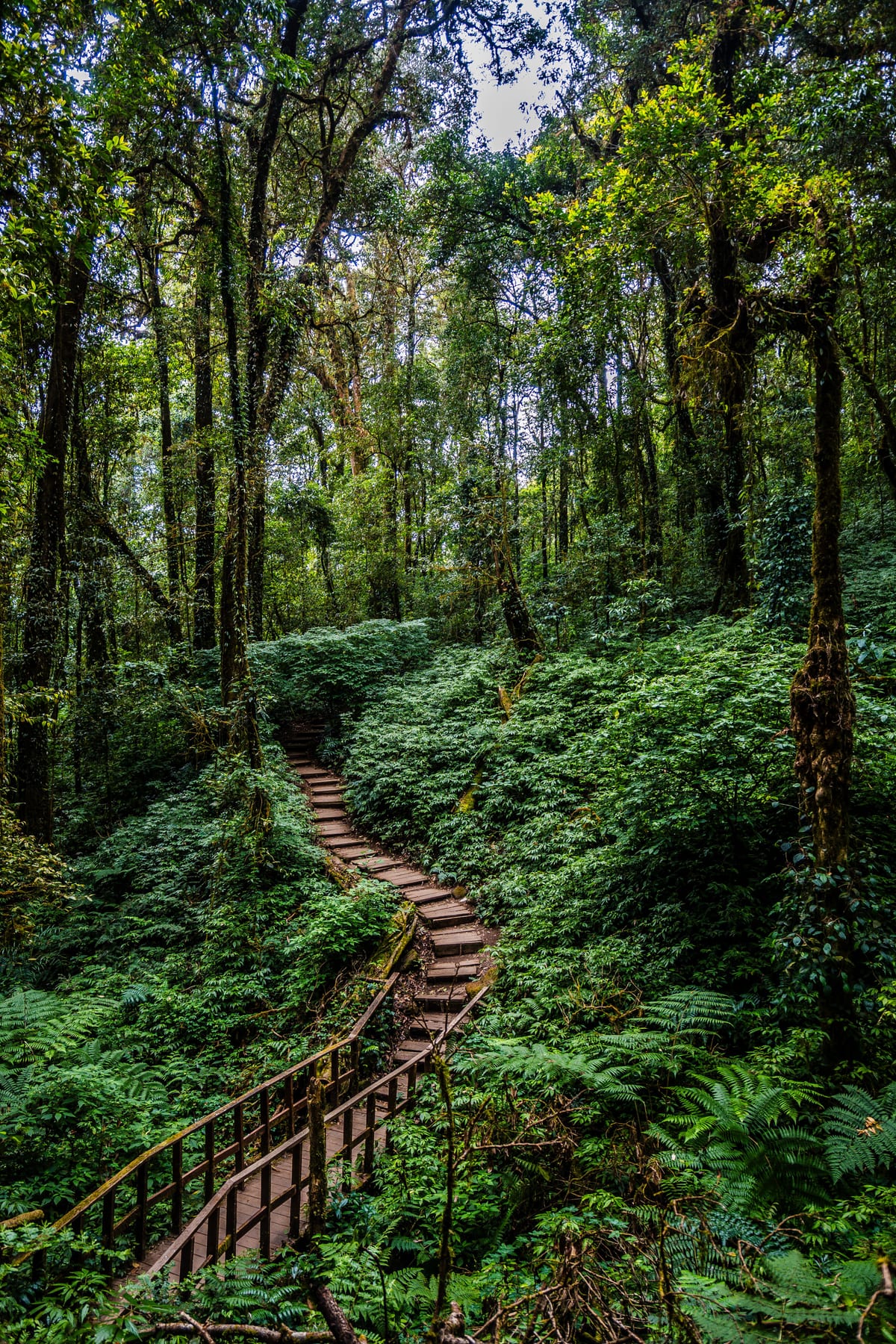
Bua Tong, the sticky waterfalls, is the stranger one, about an hour north-east. It's a limestone waterfall you can walk straight up: the mineral crust on the rock gives your bare feet enough grip to climb against the flow, which sounds made up until you're doing it. It's free, Thai families picnic there on weekends, and there's a cold spring at the top. There's no real public transport out, so it's a Grab there and back, a rented scooter, or a half-day tour.
Where to stay
For a first visit, stay inside the Old City. You wake up walking distance from the temples and the Sunday Walking Street, the streets are quieter, and it's mostly guesthouses and smaller hotels in among the old buildings. It's the version of Chiang Mai most people come here for.
Nimman (Nimmanhaemin), just west of the Old City, is the alternative if you'd trade old-town atmosphere for modern comforts: this is the café and cocktail-bar district, with malls and the digital-nomad crowd. Good for a longer stay or if you're working. The Riverside area along the Ping is calmer again, with some of the nicer hotels, a short ride from the centre. The one area I'd steer you away from is the Night Bazaar strip: convenient, but it's the least characterful part of town and it's built around the tourist market I'd skip anyway.
For how to actually book, and why Agoda tends to have the best local inventory in Thailand, see our hotels guide.
How long to spend in Chiang Mai
Three full days is enough to see the Old City properly, hike the Monk's Trail, and fit in one day trip. Five lets you slow down and add Mae Kampong or Doi Inthanon without turning the trip into a checklist. Fewer than three and you're really just sampling the place.
That's a 3–5 day Chiang Mai. Two slow mornings in the Old City temples and markets, an afternoon up the Monk's Trail, a day outdoors with the elephants or in Mae Kampong, an evening at North Gate Jazz, and as much khao soi as you can fit between all of it.
If this is your first trip to Thailand and you're still pulling the broader plan together, our first trip to Thailand checklist covers what to sort before you fly, and the best time to visit Thailand goes into more detail on Songkran and the rest of the calendar.