Tip · Go on a Saturday or Sunday and get there by about 10am. The food market and a lot of the shops only open at weekends, and the paths near the pier fill up quickly.
Koh Kret is an island by accident. In 1722 a canal was dug across a tight bend in the Chao Phraya so boats could skip the long way round, the river took the shortcut and kept widening it, and the land inside the bend ended up cut off. Three hundred years later it's a small, car-free island just north of Bangkok, and an easy half day out of the city.
What Koh Kret actually is
The island is about four square kilometres of villages, temples and workshops, joined by a ring of narrow concrete paths. There are no cars. Motorbikes use the paths, and so does everyone else. Officially it's in Pak Kret, Nonthaburi, not Bangkok, but it's a straightforward trip from anywhere in the city.
Most of what makes it interesting comes from the Mon, who settled here in the late 1700s and again in 1815 and brought their pottery with them. Koh Kret's pots are unglazed terracotta, orange to red, with patterns carved into the clay and cut right through it, and the island is still known for them. The main temple by the ferry landing, Wat Poramai Yikawat, was rebuilt in Mon style, and at the corner of the island next to it a white chedi leans out over the water. It was built straight. The riverbank started to give way underneath it around 1891 and it has been leaning ever since.
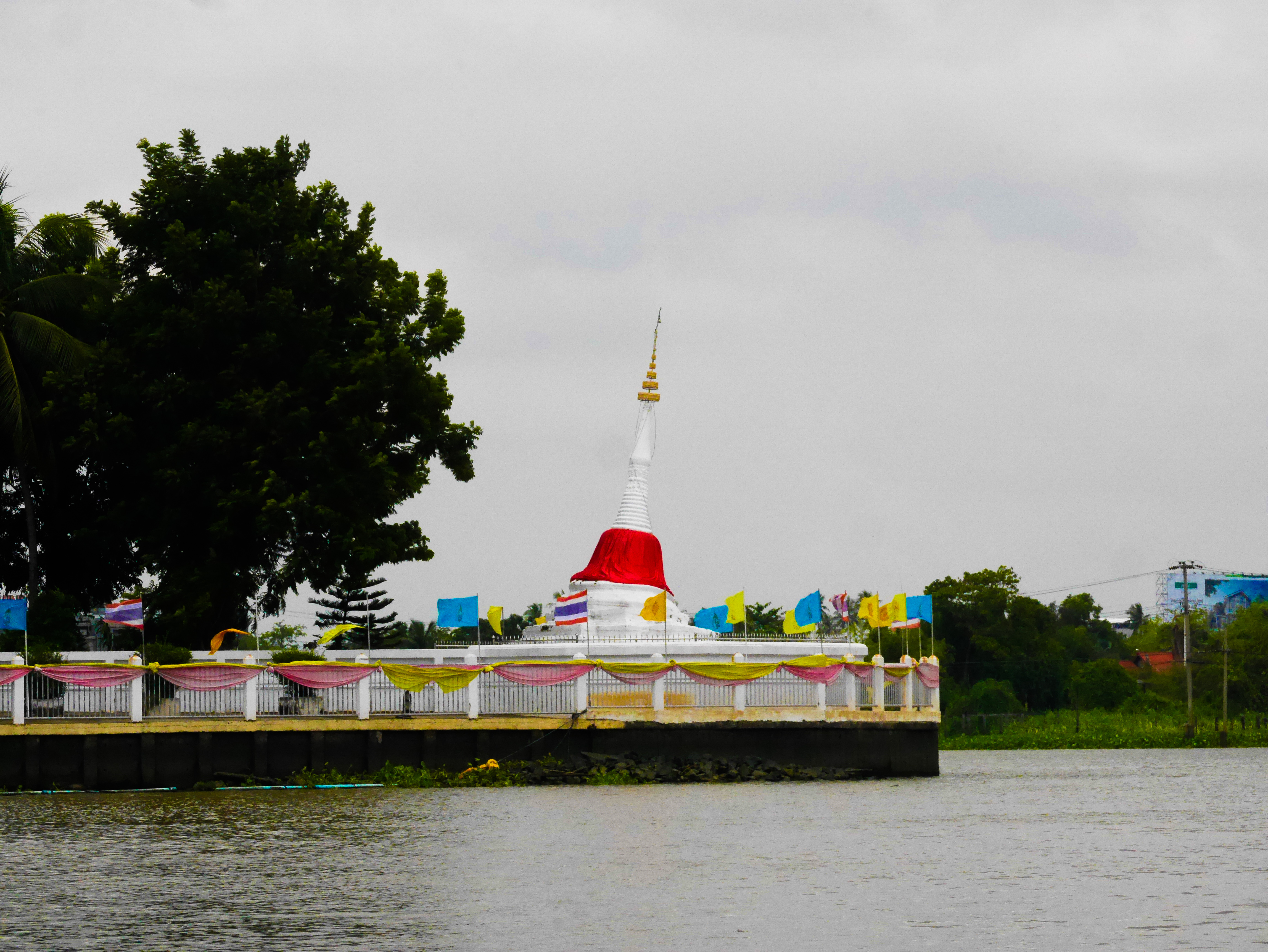
The leaning chedi at the corner of Koh Kret. Photo by กสิณธร ราชโอรส, CC BY-SA 4.0.
I went on a weekend with a group of friends. We took a Grab to the pier, crossed on the little ferry, rented bikes, rode the loop and walked around. It's a very different day from anything in central Bangkok, and worth the half day in my opinion.
Getting there
The easy way is a Grab or taxi to Wat Sanam Nuea pier (ท่าน้ำวัดสนามเหนือ) in Pak Kret. That's how I did it. From central Bangkok it takes roughly 40 minutes to an hour depending on traffic, and it drops you right at the ferry.
From there a small cross-river ferry runs over to Wat Poramai Yikawat pier on the island. The crossing takes two or three minutes and costs 3 baht during the day, or 5 baht early in the morning and in the evening. Boats run from about 5am, and the last one back is at about 9:30pm, or 9pm on Sundays. Have coins or small notes ready, because you pay on the island side.
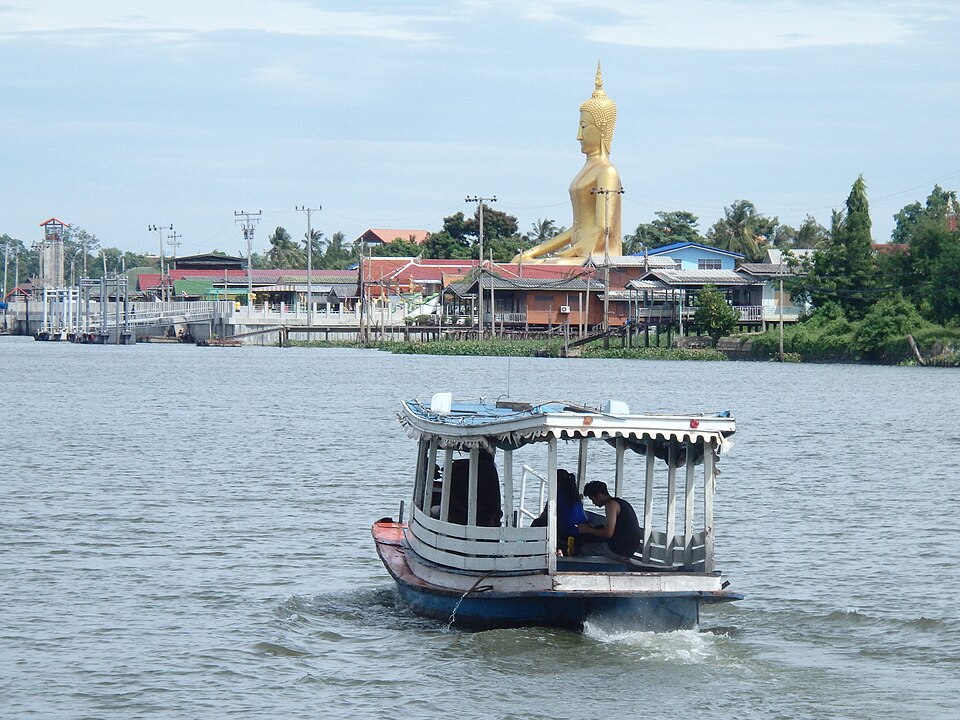
The ferry between Koh Kret and Pak Kret. Photo by mohigan, CC BY-SA 3.0.
If you'd rather go by train, the MRT Pink Line stops at Yaek Pak Kret, about 2 kilometres from the pier, and a motorbike taxi does the last stretch for around 30 baht. That makes sense if you're staying in the north of the city. From Sukhumvit or Silom it's a long ride with a change or two, and a Grab is simpler.
A lot of older guides send you up the river by boat. The Chao Phraya Express only runs as far as Pak Kret on weekday mornings and evenings, for commuters, so on a weekend you'd be riding to Nonthaburi pier and taking a taxi from there anyway. The Sunday tourist boat straight to the island that some guides still mention only runs as an occasional promotion. The last one I could find was in early 2025, so don't plan around it.
If you'd rather not deal with any of that, there's a guided tour that picks you up from a meeting point in central Bangkok and takes you round the island by bike with an English-speaking guide, which helps on an island where not much English is spoken. It includes a session on the potter's wheel, a coffee-roasting class and lunch by the river, and takes about four hours. I haven't done it myself. It's rated 5.0, though only from a handful of reviews so far, and at a little over 100 US dollars a person when I checked, it costs a lot more than a Grab and a 3 baht ferry.
Photos, price and reviews for this tour load from GetYourGuide, which sets its own cookies.
- Best for
- A half day by bike, with lunch at the weekend market
- Getting there
- Grab to Wat Sanam Nuea pier in Pak Kret, then the ferry (3 baht, 2–3 minutes)
- Last ferry back
- about 9:30pm, 9pm on Sundays
- Bike hire
- about 40–60 baht for the day, near the island pier
- When
- Saturday or Sunday, arriving by about 10am
Around the island
Bikes are rented near the island pier for about 40 to 60 baht for the day. The loop is roughly 5 to 6 kilometres of paved path, mostly narrow, with the river on one side and houses, temples and small shops on the other. You could ride the whole thing in well under an hour, but with stops it takes most of a morning.
At the weekend the stretch near the pier is packed with people walking between food stalls, and that part is easier on foot. From the pier, turn right for the snack market and left for the cafés and the pottery village. You share the paths with motorbikes the whole way round, so keep to one side and ride slowly.
The pottery village is called Kwan Aman, which is Mon for "potters' village". You'll see the terracotta everywhere, stacked outside workshops in jars and pots of every size, and at the weekend some of the potters work where you can watch. There's a small pottery museum that's free to walk into, and a few places let you try the wheel yourself for around 50 to 100 baht, clay included.
Somewhere on the way round we bought fish food and fed the fish in the river. It's a small thing Thais do to make merit (tham boon), and a nice five minutes off the bike.
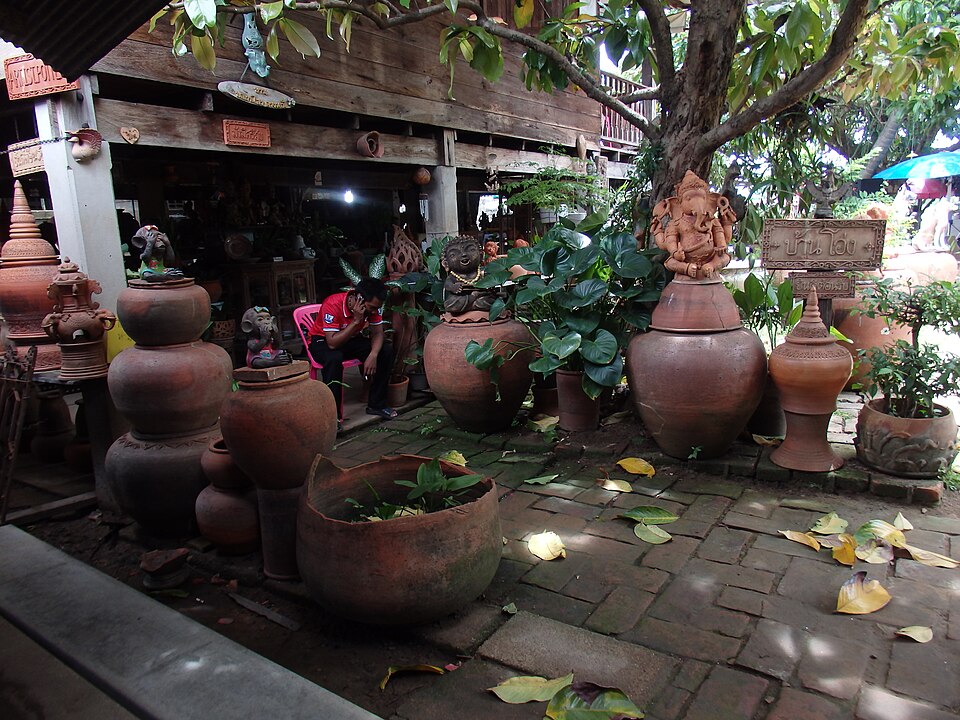
A pottery shop on Koh Kret. Photo by mohigan, CC BY-SA 3.0.
What to eat
The weekend market is where most of the Thai visitors are headed, and the food is the reason. Look out for khao chae (ข้าวแช่), rice in chilled, flower-scented water with a set of small side dishes, which started as Mon food for Songkran. Tod man nor kala is a fish cake with the crunchy shoots of a local ginger-family plant mixed in, and it's the snack the island is known for. You'll also find flowers fried in batter with a sweet chilli dip, and plenty of Thai desserts.
This is a Thai day-trip crowd and not much English is spoken, which doesn't matter, because pointing works fine. The street food guide covers the few words that help. The market runs on Saturdays, Sundays and public holidays, roughly 9am to 5:30pm. On a weekday the island is open and the ferry runs as normal, but it's quiet and a lot of the shops are shut.
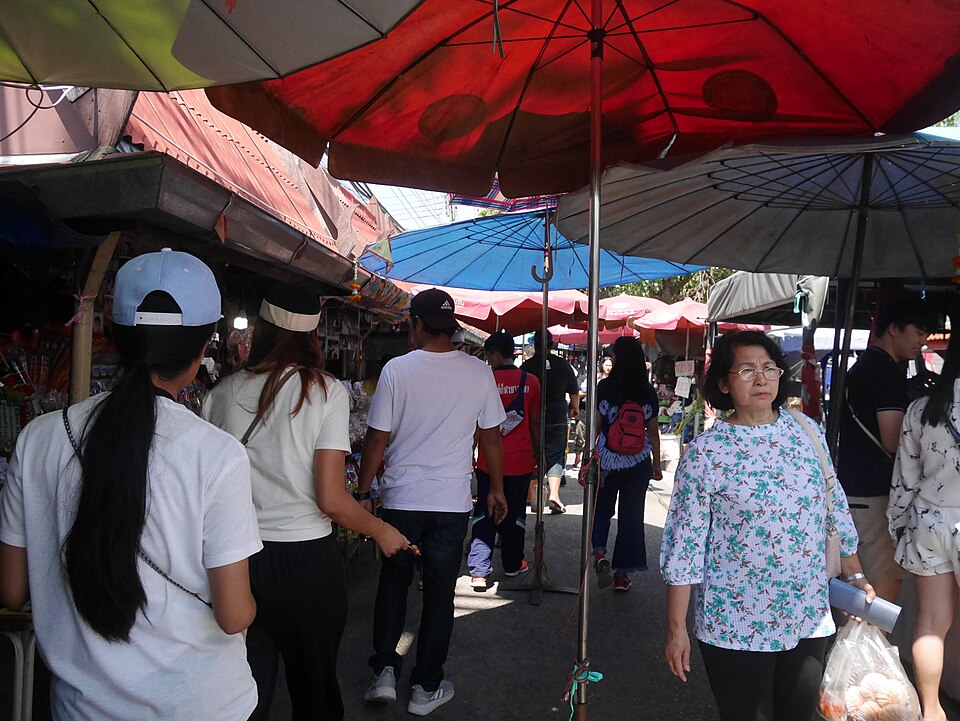
The weekend market on Koh Kret. Photo by กสิณธร ราชโอรส, CC BY-SA 4.0.
Rongsi Studio
We also spent some time with friends at Rongsi Studio, a café and restaurant in an old rice mill on the north-west side of the island. "Rong si" is Thai for rice mill, and they've kept the old milling machinery inside. It sits right on the river and it's on the loop, so you can ride straight there. Expect café prices, a couple of hundred baht for a main, which is a lot more than the market. It's open every day until 10pm, but the last ferry back leaves before that, so keep an eye on the time if you stay into the evening.
When to go
Go at the weekend, for the market. A realistic half day looks like this: leave the city around 9, be across the river by 10, ride and eat until early afternoon, and you're back in Bangkok by mid-afternoon. Stay for a long lunch at Rongsi Studio and it turns into most of the day.
The cool season from November to February is the most comfortable time to cycle. In the hot months, March to May, plan to be off the bike by lunchtime. In the rainy season the usual afternoon storm means mornings are still fine, but the paths get slippery, so slow down.
If this sounds like your kind of half day, Bang Kachao is the same idea on the south side of the city, greener and, on a weekday, a lot quieter. Our guide to Bangkok without the tourist traps has more places the tour buses skip.
Some links above are affiliate links. If you book through them it costs you nothing extra and helps keep the site running.
Trip planner
Planning Bangkok? See which days suit it.
The free trip planner shows the seasonal weather verdict for Bangkok on your dates, how long it takes to get there from your other stops, and where to book.